Showing posts with label Old Books. Show all posts

Sunday, 10 March 2013

A Letter of Introdution

 This past week I have felt rather like Florence Nightingale at the base hospital in Scutari:
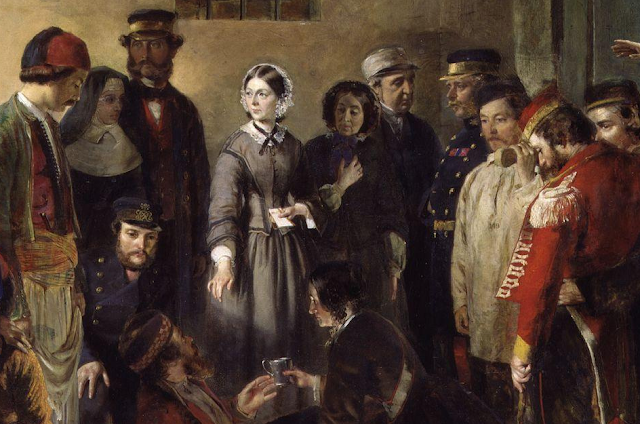

This image of Florence Nightingale is a detail of a picture that comes from Wikipedia.

Which is rather apt considering that I live in the place where she did a lot of her studies...

At present, Kaiserswerth is in the grip of a raging influenza virus that is knocking people over like ninepins.  AGA has been confined to bed with it for five days and today is his first day up and about.  He told me, that the doctor told him, that nearly half the town has it!  The usual suspects: Extreme tiredness, lack of appetite, a rumbling cough, aches and pains.  What we need is sun, sun and more sun but what we have is rain and overnight we apparently have an 87% chance of snow!  I wish Spring would get a move on.

However the purpose of this post is not to whine about illness and the weather, but rather to serve as a letter of introduction for Miss Mary Mitford and her charming book.

No, I am not referring to one of those famous (and sometimes infamous) Mitford sisters.

The Mary Mitford of whom I write was born in 1787 and died in 1855.
This image of Mary Mitford comes from Wikipedia

Here is a little something about her:
Mart Russell Mitford was born in 1787, the daughter of a Dr George Mitford who, while seemingly a very engaging personality, was a thorough wastrel and really quite a dreadful man, who spent his wife's entire fortune.
Then, when things seemed quite hopeless for the family, his daughter Mary had the good luck to pick a winning lottery ticket.  The prize was 20,000 - a large sum of money in those days and worth around 650,000 today.  Dr. Mitford with cheerful but selfish abandon, managed to spend most of that too.

It was this lack of money that spurred Mary to turn her hand to writing in an effort to support herself, and her now ageing parents.  To this end she met with some fair degree of success and while for many years the spectre of poverty was never far from the door, she was able to live a fairly comfortable life.

And while she had dreamt of becoming a poetess, and a playwright, it is for her series of country-life sketches (we might call them 'essays') that she is best remembered.  These grew out of a necessity to earn money.  The first set of sketches were published in a subscription magazine and when they proved popular, more where composed and eventually compiled in book form entitled 'Our Village'. Several more books in the same vein followed.

* * * * * *

'Our Village' is a delightful book: Both intimate and enticing.  A little window into country-life in Regency England.
The book contains no malice; no waspishness.  It is neither judgemental nor condescending.  The author is generous to her subjects and as you begin to read, you find yourself drawn into Mary's world, to extent that it is hard to put the book down!
The complete series of sketches forms a relatively large book.  I have an edition back in Melbourne but I was fortunate enough to encounter, while strolling along the Portobello Road with AGA, a truly delightful slimmer volume, dating from 1893 and consisting of a selection from the five volumes of the same title.  This forms a good introduction to her works.
The added treasure and delight of this particular book is that it is illustrated by that incomparable artist: Hugh Thomson (1860-1920).  Interestingly, the Irish-born Mr. Thomson is also known for his quality illustrations for the works of Jane Austen, Mary Mitford's contemporary and sometimes friend.

The cover (designed by the illustrator) is itself a charming piece of work, undertaken in gold leaf:
The stiff but easily removable plastic cover came with the book and I am retaining it until such time that  the book returns to Melbourne with me so that the gilding on both cover and pages, remains as bright as when it was first published.

The frontispiece gives an indication of what to expect within:

'...And one hundred illustrations by Hugh Thomson' -  Who could ask for more?

Here is the opening paragraph of the first sketch, which is entitled 'Country Pictures':
"Of all situations for a constant residence that which appears to me most delightful is a little village far in the country; a small neighbourhood, not of fine mansions finely peopled, but of cottages and cottage-like houses, 'messuages or tenements', as a friend of mine calls such ignoble and nondescript dwellings, with inhabitants whose faces are as familiar to us as the flowers in our garden; a little world of our own, close-packed and insulated like ants in an ant-hill, or bees in a hive, or sheep in a fold, or nuns in a convent, or sailors in a ship; where we know every one, and are known to every one, interested in every one, and authorised to hope that every one feels an interest in us.  How pleasant it is to slide into these true-hearted feelings from the kindly and unconscious influence of habit, and to learn to know and to love the people about us, with all their peculiarities, just as we learn to know and to love the nooks and tuns of the shade lands and sunny commons that we pass every day."

The illustrations are charming:


And each chapter has a delightful illustration to accompany it:

The character studies of the various inhabitants leaving one feeling that ones knows them as well as Miss Mitford did.  You can feel the affection she has for her fellow villagers, from the eldest down to the youngest.
One can tell that she has a deep love for the countryside and this shines forth in her descriptions.  Her love of animals is also evident and her description of village cricket (a sport she loved to watch) has led to her being described as being among the first to write on the subject.

I do like the description she gives of her own house and garden:
"Divided from the shop by a narrow yard, and opposite the shoemaker's is a habitation of whose inmates I shall say nothing.  A cottage - no - a miniature house, with many additions, little odds and ends of places, pantries and what not; all angles, and of a charming in-an-outness; a little bricked court before one half, and a little flower-yard before the other; the walls, old and weather-stained, covered with hollyhocks, roses, honeysuckles, a great apricot-tree; the casements full of geraniums (ah! there is our superb white cat peeping out from among them); the closets (our landlord has the assurances to call them rooms) full of contrivances and corner-cupboards; and the little garden behind full of common flowers, tulips, pinks, larkspurs, peonies, stocks and carnations, with an arbour of privet, not unlike a sentry-box, where one lies in a delicious green light, and looks out on the gayest of all gay flower-beds.  That house was built on purpose to show in what an exceeding small compass comfort may be packed."

I recommend to you, not only Mary Mitford but her wonderful book as well!  Do see if you are able to buy a copy, or if that proves impossible then to borrow one from your library.

Saturday, 19 January 2013

Good Book Hunting

It is very cold outside, and has been all week with snow on and off - and more expected.

So what better way to spend a cold Saturday morning than with a nice cup of tea, the occasional peppermint cream and/or white chocolate and raspberry biscuit, and a big pile of 'loot' bought back from our holidays.

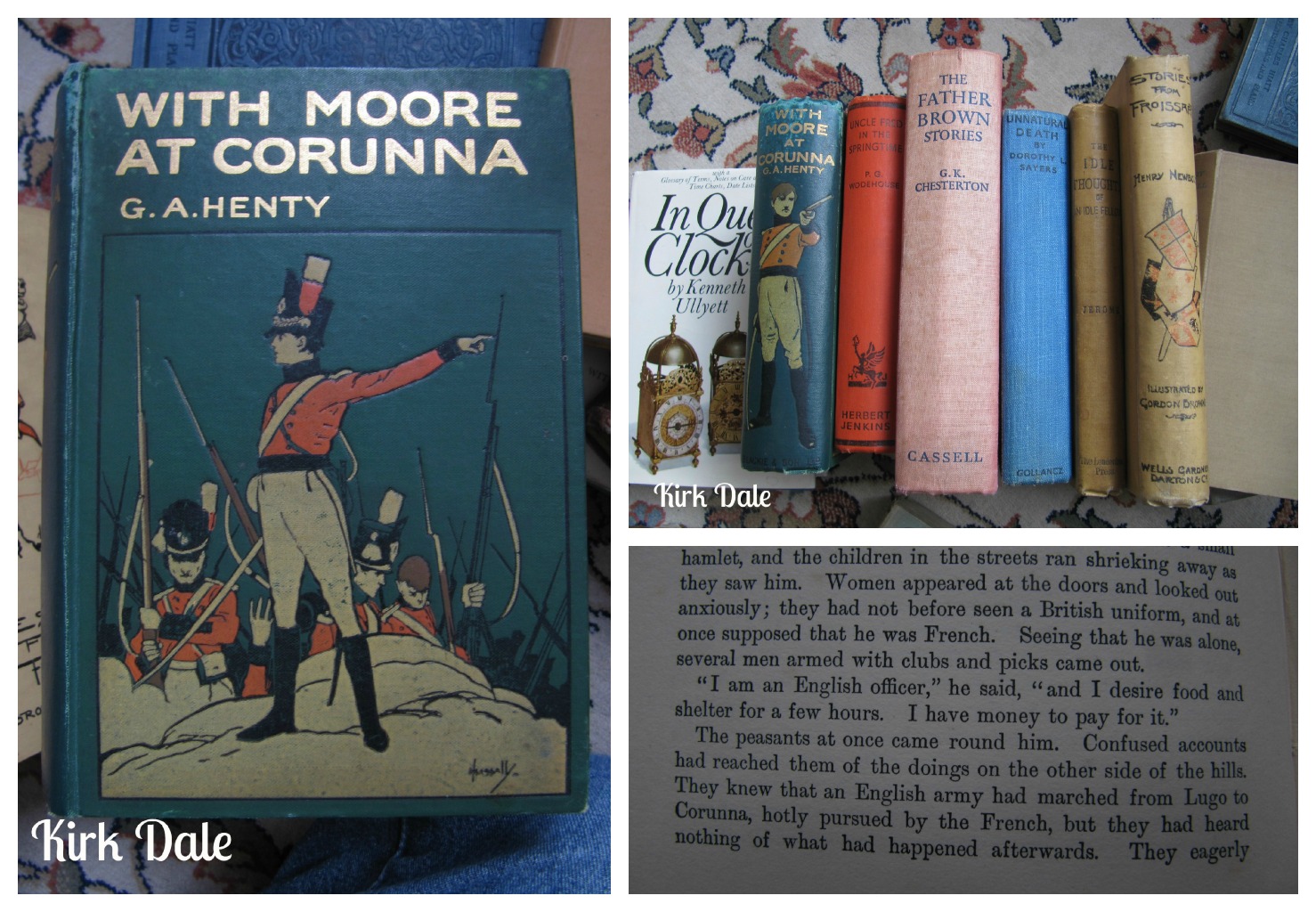
By loot I mean books:


The first step was to put them in to piles:


And then came the infinite pleasure that is browsing. . .

First up:
'The Art of Dining' by Sara Paston Williams
'Italian Cooking' by Nella Whitfield
'100 Cocktails' by 'Bernard'
Nella has a recipe on how to cook 'Chicken as served in Rome' and I make a mental note that I could try making this myself later on.
'Bernard' intrigues me.  Who is he?  Or she?  I see that Bernard knows how to make a Florida Cocktail which might interest Mark Ruffner over at All Things Ruffnerian . . .  There is a Champagne Cobbler (I always wondered what was in those).  No 'Blue Witch' though (I had this at a hotel AGA and I were staying in while holidaying at Wernigerode some years back and really liked it) perhaps it hadn't been invented back in 1958 when this book was written. . . 

Suddenly I remember that I must get the parmesan and rosemary biscuits out of the oven. 

I only bought one 'old' gardening book this time.
'A Book About Roses' by Dean Hole.
Dean Hole was the Rev. Samuel Reynolds Hole, Dean of Rochester.  An avid gardener, he wrote many books.  An expert on roses, he was also incurably romantic and he tends to veer off into flights of fancy when describing flowers.  Sellars and Yeatman in their book 'Garden Rubbish' make fun of both him and Beverley Nichols.
I am pleased to have finally found this book to add to my collection.  Here he is writing about why the rose should be in every garden:
Erika over at Parvum Opus would love this book because the pages were hand cut and some were missed out so that when I cut them myself (using a paper knife) I am the first person to touch the page since it was published back in 1903.

I also picked up some works of fiction:
'The Father Brown Stories' by G. K. Chesterton
'The Idle Thoughts of an Idle Fellow' by Jerome K. Jerome
'Uncle Fred in Springtime' by P. G. Wodehouse
'Unnatural Death' by Dorothy L. Sayers
'Stories from Froissart' by Henry Newbolt
'With Moore at Corunna' by G. A. Henty

I enjoy reading the Father Brown stories: short, very clever, and with results that are not always guessable.  Wodehouse and Jerome always make me laugh and these two books are missing from the collections I inherited from my father.
Lord Peter Wimsey is a hero of mine.  Dorothy L Sayers was such a skillful writer of crime fiction.  I think that I now have the 'set'.
Henry Newbolt (of 'The Highwayman' fame), later Sir Henry Newbolt, is someone I could read a lot of and never get tired.  I think I shall enjoy his book too.
And as for G A Henty - when I start reading his books it is difficult to put them down: filled with historical facts, plenty of daring-do, lots of scrapes and mishaps but always a happy ending for the hero.  What more could I want?

'Seeing that he was alone, several men armed with clubs and picks came out.
"I am an English officer," he said, "and I desire". . .'

I have to close this book otherwise I shall sit reading it and not finish the work at hand.

Look at this frontispiece for Henry Newbolt's book:


Isn't it wonderful?

AGA likes buying books on interior design.  I do too.  We found a goodly number among which are these:

This one looks very interesting:
It is the sort of book to lay on the settee with, and browse though when one should be doing something else.  The picture in the bottom right shows the beginning of the chapter on wallpaper in America.

Now, these two books are quite a find as far as I am concerned.  They form part of a series called 'The Picture Guides' published by the Medici Society back in the early 1930s.  These two are 'Florence' by Pierre Gauthiez and 'The Country Round Paris' by Edmond Pilon
Poetic in their description, these books are enchanting to read.  I already have two others (including The Land of St. Francis Assisi) and I see that there are still nine more for me to get.

I was very pleased to get these books too:

'The Celtic Border Land' is of course the Welsh Marches where we spent our holidays.  It made a nice souvenir to take away with us - especially considering the fact that after having purchased it, I saw a copy for sale is another shop, but at an higher price.

'The Story of Venice' is part of a series entitled 'Medieval Towns'.  Part history and part tour guide I think that this edition on Venice would get Jane and Lance Hattatt's immediate attention. I intend to take it with me next time AGA and I go to Venice:

'The modern visitor arriving by train is like one who should enter a stately mansion by the stables.  Once however, in his gondola, the 'black Triton' of the lagoons, gliding along the waterways to the strangers' quarter by lines of house and palaces, whose walls timeworn or neglected, sometimes degraded, will be mellowed under the dim light of the infrequent lamps, he will be caught by the spell which Venice casts over those who come to her.'


This book caught my eye:
Written by the brother of the artist, Rex Whistler, it is a book that explores the history and origins of English festivals.  The picture of your right shows Christmas decorations in England prior to the introduction of the Christmas Tree.  That might be something to experiment with next year!

Now the book on your left is on a subject dear to my heart: The Early Georgian Period.  I have already browsed through this and I can tell you that it is a very good read.  On your top right is a series of books on English Cathedrals.  The books, often written by the Cathedral Deans or the Bishops themselves, provide a fairly in-depth history of the buildings as well as explaining the layout, design etc.  Look at the detail on the cover of the volume on Exeter Cathedral.  I really like this sort of thing.  These will join the others that I have in the same series, back in Melbourne:

Last but not least are these two books about Melbourne.  If you care to take the time, Melbourne is an absolutely fascinating city to study.  I love it!  AGAs ancestors were among the first settlers of Melbourne back in the late 1830s so I have a vicarious link to the place.  Whenever I am book hunting I keep an eye out for anything on Melbourne that might interest me.  These two did.  Printed in the 1950s they are pictorial essays on the city.  These are the sorts of books I can imagine my blogging friend Faisal having in his book collection.  One in particular I consider quite a find: Tasmanian born Jack Cato was a Fellow of the Royal Photographic Society, an historian and a world renowned photographer.  His black and white portraits of the city of Melbourne are excellent and to think it was located in the depth of the Welsh countryside.

Sometimes you get into such a book hunting frenzy that when you get home you find you bought something you already have!


I shall send the second one to my nephew, William!  He loves reading and I am hoping to encourage within him a love of old books, just as my father did in us.

Many of the books shown in this post came from the Great Book Hunting Expedition that we undertook here:

Others were tracked down at various locations throughout the Welsh Marches.


So, I don't care that when I look out of the sittingroom window I see this:


I am more than happy to sit comfortably, ensconced in a corner with my books!

Tuesday, 23 October 2012

A pleasant, bookish, Interlude...

This week my life is taken up with some important work commitments. It makes me wish I were still on holiday... 

Today however, something rather special arrived in the post.  

A little purchase I made on e-bay.

Here it is:
This Photograph was taken by Kirk Dale.
It looks fairly ordinary doesn't it?  

An ordinary, brown, leather covered book.  

Ordinary size.  

Ordinary shape. 

No illustrations . . .

But wait!

Once you open the cover and begin to read, then you are 'transported', because this is no ordinary book my friends.  This is in fact the 2nd edition (1836) of "The Manse Garden" by The Rev. Nathaniel Paterson.

This Photograph was taken by Kirk Dale.
And what a book it is!

On the surface it is a book about gardening on a smaller scale, to counteract the many books written about gardening that were aimed at the wealthy, landed gentry: people with a small army of gardeners to attend to their desires.  
Dr. Paterson's audience are those members of the upper and affluent middle classes, who have a smaller plot to work with and a 'man or two' or perhaps even a 'gardener's boy' to assist them.

But it is the writing, the poetry of words, that makes this book a thing to treasure.

The first part of the books speaks of trees.  Here I have transcribed the first paragraph for you:

"Of all the trees of the forest, the native holly is the most interesting and beautiful.  Whether young, as a shrub in the garden, or old, as a lonely tree of the mountain, its glowing fruit and glossy leaves, gleaming in the winter sun, prove the delight of all eyes.  It allures to its own hurt the mischievous schoolboy; it is the laurel of Burns, and the sanctuary of the singing birds.  Shielding its songsters from the hawk, it shelters them in the storm, and feeds them with its fruit when other trees are bare.  It does one's heart good to see the humble blackbird picking a red berry amidst the falling snow."

Already you, the humble gardener, are falling in love with this tree, and he hasn't even got to the technicalities of planting it yet!

The book covers all aspects of gardening, written in a style that is at once both informative and poetic.

And then there are the unusual and sometimes exotic lists of the various varieties of plants - some of them sounding like the stuff of fairy tales.  Take this list of fruit trees that can be grown against a wall:
This Photograph was taken by Kirk Dale.
Some of course we know such as the May-duke Cherry, but I can find no record of the 'Green Pear of Yair'.
I have even consulted my 1788 copy of 'Every Man His Own Gardener', where all sorts of unusual varieties can be found - but it isn't there. 
I wonder what it looked like and if it still exists! (Perhaps you know?)

I do love a book that raises questions and tantalises with possibilities. . .

I have read only the first few pages of this book as I am saving it to take with me on my journey to Budapest on Thursday (I must attend a working conference on school libraries). I want something to look forward to at the end of the day as well as to while away the journey.
I have of course dipped here and there and I know I am going to enjoy listening to Dr. Paterson although his views on cucumbers are interesting to say the least!

I love books.  

I really love old books.  

And I have a feeling that particular one is going to be among my favourites.


PS
You can read a short biography of Dr. Paterson here.  He sounds like an interesting chap.