Monday, 18 November 2013

One large slice of Jacobean Heaven!

When we were back in England for our summer holidays, we visited (as one does) various country houses.  
As members of the National Trust, we were eager to see some of the more 'out of the way' houses; ones that were off the beaten (tourist) track.

One such house was Chastleton: a fabulous, drop dead gorgeous, Jacobean manor.
We had tried to visit Chastleton one Christmas a few years ago but it was closed at that time.  This time we made sure it was open before motoring over to see it - only to find that we had arrived half an hour before closing time!
One week later we were back.  Chastleton was open and ready for business - and we were in Jacobean Baroque heaven!
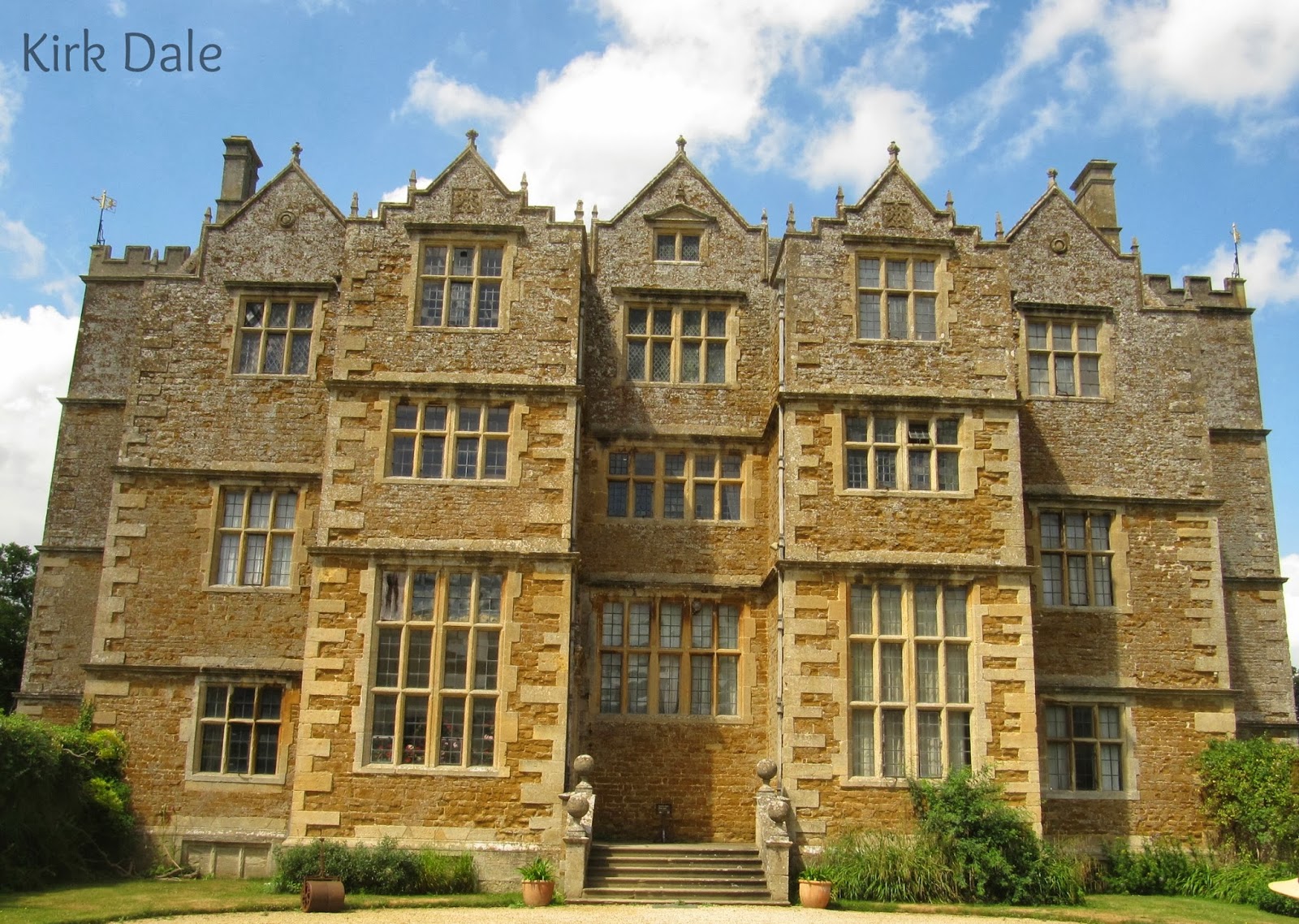


Armed with our guide book and iPad camera we spent a very enjoyable time poking into every nook and cranny the house had to offer; and now it is your turn: So polish your shoe buckles, fix your ruffs, doff your caps and come with me as we go on on a little tour of this wonderful 17th century time capsule.


Chastleton was built between the years 1607 and 1612 by a man named Walter Jones. He had bought the site from the infamous Robert Catesby (of Gunpowder Plot fame), after that man had sold it to help pay a huge fine to the Government after having taken part in the revolt of the Earl of Essex back in 1601.  Walter had plans drawn up which resulted in the existing house being pulled down and a new "modern" house built in its place. The result is Chastleton House as we see it today.

Walter's people had been successful Welsh wool merchants while for his part, he had made a name for himself as a lawyer. The house he built remains little changed since his time and stayed in his family for the next four hundred years before being handed to the National Trust in 1991.  Little changed over the years because the family gradually became impoverished and had not the funds to do anything in the way of modernisation.  To quote from the guide book:

"Barbara Clutton-Brock, the last owner, often said that 'poverty is a great preservative'.  Lack of funds had held her Jacobean house and garden in such a suspended state that its remarkable survival was of national significance." (page 2)

The Trust decided not to renovate the house, but to conserve what was there, and what a fab job they have done!
No flash photography was allowed and so I took photos as best I might, using my iPad, but some rooms were too dark and some photos just didn't come out right at all.

Here is the White Parlour:

The plaster work is wonderful, as is the old 'turkey carpet':

I like the way the ancient tapestries are not hung necessarily for display but rather to serve their original purpose, which was to keep out the cold.  Here a Teniers tapestry hangs similar to a curtain in the great parlour, with a chair and an old wooden writing box nearby:
(Note the ever present teasels to stop anyone attempting to sit on the fragile old chairs)

The Great Chamber has a monumental fireplace emblazoned with the arms of the builder, Walter Jones.

I like the way this portrait is hung so that the light from the lamp illuminates two two porcelain vases while at the same time shining up onto the painting.  It isn't perfectly done and I guess that a proper picture lamp should have been used, however, this is how it was when the family lived there and it 'works'; giving the home a true 'lived in' look rather than a 'museum' feel...

This room is known as the 'Cavalier Room'.  It is called this because unbeknownst to the parliamentary troops were sleeping in there during the English Civil War, the owner of the house - Arthur Jones, who at that time was the local Royalist fugitive for whom they were looking - was hiding in the secret room next door.  After having had their wine drugged with laudanum by his wife, Arthur was able to slip out through this room, past the sleeping soldiers, take one of their horses, and ride swiftly away in to the night!   The bed is of the period as is the linen on the bed:
The reason that the linen remains here is that Anne Jones, wife of the then owner, was a frugal person who was widowed when relatively young.  She managed to lift the family out of debt and made these sets of linen for her daughters once they were married.  They were to receive then once they bore children.  Unfortunately her daughters never did have children and so consequently, the linen was never given away.

This is the secret room, where Arthur Jones hid from the parliamentary soldiers sleeping next door.  I like the simple oak wall panels and the way that the large paintings is set on the floor:

Here is a view down the East staircase.  It is dated 1636 but was rebuilt in 1830.  This was the staircase for important visitors so it is somewhat apt that you can see AGA's feet in the bottom left hand corner...


At the top of the house, it is possible to enjoy one of the wonders of England: the Chastleton House Long Gallery.  Running the entire 22 metres length of the house, this is the 'longest surviving barrel-vaulted ceiling of its date in England':

I couldn't get the entire length into the photograph but you get an idea of what it looks like.  That trunk on the right wall is Spanish and probably dates from around 1500.

Everywhere one looks, one see treasures.
Look at these wonderful carvings and plasterwork:


There are paintings:

Cabinets and curiosities such as this old hearing trumpet

The play of light and shadow in unexpected corners:

And more decorative plasterwork than you can poke a stick at:

(This is also in the Long Gallery)

Just look at this old long-case clock in the hall.  It has a lenticle so that one can see the pendulum swinging without opening the door:
(The clock is somewhat dusty but such things sits well in this old house)

Down in the kitchens, the original range sits just as it was when the last owners were in residence:


For some reason I don't have many photos of the gardens.  They were more of the green and bushy type rather than the colourful, floral variety:


And in the adjoining field stands the family dovecote (an important source of foods for the Jacobean household):

I hope you enjoyed this little visit to Chastleton House.  If ever you get the opportunity to visit then I would thoroughly recommend it!


Sunday, 10 November 2013

What a difference a couple of weeks make.

We have been living in a whirl of activity over the past few weeks - most of which were spent in Melbourne.
During that time we were able to see our garden in flower.  This does not happen often as we are usually there in Winter when all is asleep.  This time however we were there and I was able to see one of my favourite roses in bloom: Papa Meilland:


We were also able to visit our other harpsichord, a single-manual, Flemish instrument that AGA built from a kit back in the mid 1980s.  Like some wines, it has improved with time and now has a wonderfully silvery, harpsichord voice - perfect for the music of François Couperin.  AGA and I had a lovely time re-aquainting ourselves with our old Flemish friend!
For those of you who are interested in clocks, the long-case beauty you can see next to the harpsichord is an English 30-hour silvered-dial antique, made by Samuel Holbin in around 1750.


We also took a few hours to motor up to the Dandenong ranges to see the rhododendrons and azaleas in flower.  Mount Dandenong is famous for these beautiful trees and shrubs, and people journey just to visit the famed Rhododendron Gardens.  We had not time to visit but we saw quite a few in flower in the various villages we passed through:


Despite the fact that it is mid Spring, the weather in Melbourne was somewhat cool and damp.  On a couple of days it was warmer in autumnal Germany!  On our last day however, it was a lovely mid 20s day and we were able to take breakfast on the terrace.  It was cool but pleasant and the sky was clear with not a hint of cloud:
I love days like that.  It is rare to have blue skies here in this part of Germany with its endemic air pollution.
* * * *

The purpose of our visit to Melbourne, was to be with AGA's father (ACA), who is gravely ill.  He is suffering from cancer in both his lungs and his spine.  It causes his a lot of pain, but he is a strong man - both physically and mentally - and I think that this is helping him despite the fact that he endures so much.
I admire him in his adversity. 
He is not letting his illness get him down and is living as normal a life as he can.  We were able to spend a lot of time with him and it was difficult to say goodbye, especially for AGA.  I do not think we will see ACA again, despite the fact that his doctor gives him a year at the most.
When we left, ACA said to me: "There's nothing I can do about this (the cancer).  My name is in the hat, and I'm just waiting for it to be pulled out."
And so he remains living at home, on his own, as is his wish (although AGA's siblings hover protectively on the sidelines) pottering about and trying to carry on as he has always done.
And he is sensible about his condition.  When he was unable to sleep because of the pain, he called the ambulance to take him to the hospital.  His medication was altered and he returned home.
I do hope that if I am in a similar position, that I too can be as philosophical about it all.

* * * *

We have been back here for just over one week now and the jetlag was horrible for a couple of days.
When we left Kaiserswerth it was green and pleasant with just a hint of autumn in the air.  
What a difference a couple of weeks makes!
We have returned to grey skies and Autumn in full swing.  The storms that took place before we got home contributed to blowing many leaves from the trees before they turned yellow.  Combined with the change in daylight saving we now leave for work in the dark, experience grey days, and return home in the dark.  I took this view from our sitting room window to show you what things are now like:


With Autumn ruling our lives we know that Christmas is not too far away.
They are forecasting snow for every day this coming week (but I don't believe it will happen), and the Christmas markets will soon be open for business.  This has spurred me into activity and so this weekend I have made the mincemeat for our Christmas pies:

It is an enjoyable task and scents the very air itself with a foretaste of Christmas soon to come!

(Meanwhile, in a dark subdued corner (and covered in a tea cloth) the bowl of fruit for the Christmas cake sits silently sousing in a brandy bath)

* * * *

One last thing.
When we returned home there was a package waiting for me.  Opening it carefully, I soon unwrapped this beauty:

It is a 19th century, Japanese cloisonné ware vase showing bullfinches flying amongst Chrysanthemums.  The sky is blue with fluffy white clouds and the flowers look as if they are waving gently in the autumn breezes.  It is beautiful and I am so glad I purchased it.  One of these days it will sit in pride of place on some table or other, but for the moment it stands quite sedately next to a clock, a lamp and a statue of St Florian.

Friday, 18 October 2013

Flying visits

Well, we are off again.

I will be away from my blog for two to three weeks.

We are visiting Melbourne because AGA's father is gravely ill.  He has been ill for a few months and while he is a strong man both physically and mentally, we are told that there is little hope.  He has been given one year at the most.

Of course such predicitions are just that: Predictions.  No one can really know the length of another person's days, and as a colleague of mine pointed out only yesterday, the condition all each of us is 'terminal', from the day we are born.

So we are going back to see AGA's Father; to be with him; and to spend time in his company.

It is at times like these that the tyranny of distance comes into it's own.  Even in these days of e-mail, and skype, and all the other niceties of 21st Century life that have made instant gratification a by-word for modern living; there is nothing like being 'there' - rather than doing so vicariously from 'here' via a length of fibre optic cable and a satellite...

On the bright side, we will also be there for my Mother's birthday - the first time in ten years that this has been possible, and we will be in Melbourne, which is always a nice place to be.

So I will say adieu for the moment, and we will be back in early November.

In the meantime, I have left you a couple of glasses of cider, and a 'Homes and Antiques' magazine for you to enjoy yourself with:


Oh, and there is also a copy of 'Daggers in the Forum' by Keith Richardson if you are interested . . .

Tuesday, 15 October 2013

It was his fault.

I was supposed to put this post on my blog yesterday but AGA was watching the movie 'Julie and Julia' and I got 'hypnotised' - before I knew it it was time to go to sleep and I was nowhere near finishing my post!


So anyway, there we were . . .
(In Paris)
Paying a visit to a local flea market, when I saw him sitting forlornly on a table: Dirty, uncared for, in a frame that had seen better days.  A sad reflection of his once glorious past.
I couldn't walk passed and not rescue him!  
So I did.  
He cost me 1 euro.
I was excited although AGA had his doubts.
I knew I could smarten him up and give him back his dignity.
Once we were back home I got to work.  I cleaned up the frame and repainted it in gold.  I replaced the backing board, cleaned the glass, and gently cleaned the image itself.  
I didn't think to take a 'before' photograph but here he is restored:


When he had his photograph taken, he clearly wanted to look his best.  He is wearing his dress uniform and his medals.  I guess this is his 'best side'.  
And he wrote a very nice 'with love' message at the bottom and signed it.  
He never thought that many years later he would up for sale at a Parisian Flea Market, for the bargain price of 1 euro!
Many thoughts enter my mind when I look at this photograph.
I wonder when it was taken.  
I wonder what the occasion was, the name of the sitter, and what his life was like.  His signature is a somewhat difficult to decipher, but his medals and sash seem to indicate that he was someone of no small importance in the French military establishment.  

I didn't realise it at the time but he was to become my first photographic refugee: the doyen of my future collection.

Number two arrived about a year later.  
We were in Sorrento and strolled inside a somewhat gloomy second hand shop (as one does) for a look around.  
This one lay on a table.  
Postcard sized. 
Covered in a thin film of dust.  
I looked at the chap in the photo: He was standing there with one hand behind his back, the other resting on a pot stand or some such thing.  I wondered what made him decide to have his photograph taken on that particular day... 
I presume that the photograph was taken in the Edwardian period and the subject appears to be wearing galoshes - an odd thing to wear when having your photo taken.  Perhaps he was out with friends and they decided, on the spur of the moment, to have some photos taken of themselves and made into postcards.

I told AGA I was going to buy it.  It cost 1 euro too!  My second photographic refugee had found a home:


After that I seemed to be seeing old photographs all over the place.  Some were inexpensive.  Some were very expensive!  I bought one or two and began to keep them in a box: The plan being to frame some and place others in an old album.

That was about three years ago and my collection is slowly growing.  My reasons for collecting are not 'just for the sake of it' but because I am very interested in social history and these pictures are windows in to a past that is long gone.  I also like to see if I can find out about the photographers themselves as they are the artists who 'pulled it all together' to create the finished product...

Please allow me to share some of my collection with you.  Perhaps you collect old photographs too!

This one was taken at the Martin Balg Studio.  Martin Balg was a famous 'Hof-Fotograf' (Court Photographer) in Berlin, during the late Victorian, and Edwardian period.  
The subject of this photograph has had her hair 'done' especially for the event:
The background is more natural than in the previous photograph.  One seems to be in an elegant drawing room.  There is some sort of 'arty' magazine laid out on an upholstered bench, and the subject holds  a slim bunch of what I take to be Narcissi.  She has a rather nice wrist watch on, as well as one of those old bar brooches on her dress. 
I wonder what thoughts passed through her mind as she stood there waiting to be 'snapped'?

On the back of the photograph is Herr Balg's advertisement:
He states that his artistic photographs are all taken using modern methods.  He is clearly making a lot of money and has a telephone number for clients to use when wanting to contact him!

The next photograph has a more sombre background.  It was taken at the Wertheim Department Store, situated on the Leipzigerstrasse in Berlin.  Wikipedia tells me that this Department store was the Berlin equivalent of Harrods in London and Galleries Lafayette in Paris.
I wonder who this young couple are.  I presume they are married as she is wearing what I take to be a wedding ring.  He is wearing a frock coat and has his hands behind his back: The pose of a successful man.  I wonder what he does for a living?
Her hands meanwhile are folded demurely in front but I see a determined face and an inquiring, somewhat imperious look.

This photograph of a little boy in boater hat and eton collar was taken at the Atelier Wesseman, at Bahnhofstrasse, Cassel (also known as Kassel).  They have made him wear a large polkadot bow, and have given him a hoop to pose with.  The background is set up to make it look as though he is standing on the terrace of some large country or town house.   One hand rest on his hip.  There is a resigned look about him as if he does not enjoy this 'garb' but is putting up with it while his photograph is taken:


Now to my mind, this lady is a school teacher, with her sensible hair, her glasses and her somewhat dour attire.  She has an interesting brooch on her blouse, which looks to be in the shape of two conker (horse-chestnut) cases.  She had her photograph taken at the studio situated in the Oberpollinger Department Store (opened 1905) in Munich:

Meanwhile, when this young chap decided to have his photo taken, he chose the 'power' look: arms folded defiantly and legs crossed. 
He gazes at us with a somewhat superior air:

The artist of choice was the Bavarian Court Photographer, Franz Xaver Limbrunner, who had a studio in the town of Straubing.  I do like his advertisement on the back of the photograph: 


Now this chap is wearing his gloves, cap, outdoor coat, pinz nez glasses and a very severe look... 

He decided to have his photograph taken with his stick in his hand as if he were just about to go out.  His legs are crossed and there is an air of impatience about him. It is as if he is saying 'get on with it - I haven't got all day!'  
N. Raschkow Jr. took the photo.  You could find him on the 1st floor of No. 4, Ohlauerstrasse, Breslau (now Wroclav, in Poland). I think Herr Raschkow's charges are fairly pricey as he states that he is Court Photographer to the Dukes of Saxe-Meiningen, the Grand Dukes of Hesse, Prince Georg of Prussia, and Princess Louise of Prussia as well!


This is Max de Pausinger in the year 1877.  I don't think that he is very old in this photo and I am wondering if he is related to Franz Xaver and Clemens von Pausinger - two fairly well known artists of the period.  His pins-nez give him a scholarly air and he has an interesting hairstyle. He has had his photograph taken while wearing his overcoat:
The photographer was taken by J. Albert of Munich who states that he won an honourary diploma at the Vienna World Exhibition of 1873. He proclaims that he too is a Court Photographer:  to the Courts of Bavaria and of 'Imperial Russia'.

The next subject also decided to wear his overcoat when having his photograph taken.  
It is interesting to see the clothes people wore when deciding to have their photo taken: The clothes they thought would show them off to their best advantage.  When this man (I can't read his name) made that choice he decided upon his overcoat with the thick fur collar.  His very curly hair gives him a gipsy-ish air...
I think he may also have a faint moustache but I am not sure.  Did he fancy himself as a bit of a ladies' man?  Residing in Leipzig, he chose the photographers Eulenstein.  They are to be found at the corner of Tauchaer Strasse 29, opposite the Clubhouse. They have a nice advertisement on the back of the photo too:


To date, most of the photographs I have collected are German, however I do have lots of others, including the next one, which is among my favourites.  
It was taken by the famous photographer, Henri Claudet (1829-1880) of 107 Regent Street, London.  The subject is posed with one finger touching her cheek.  In her other hand she holds a flower.  The scalloped sleeves of her dress are fab and give it a somewhat medieval flavour.  The whole effect is very theatrical and I wonder what the rest of her dress was like. 

We have be moving slowly back in time and here we are in the 1860s:
Anna (I can't read the rest of her name - perhaps you can) had her photograph taken by J. Ebehardt in Mergentheim, a famous spa town in Baden-Wurttemburg.  She stands rather stiff and formal, with one hand on a table containing a vase of flowers.  Perhaps this was her very first time having a photograph taken.  I do like the fact that someone has coloured in the flowers she holds in her hand: 
 

My final example also comes from the 1860s.  It was taken in Celle (northern Germany) by a photographer named E. Glier.  The subject (an older woman) is seated in an ornate chair and looks up inquiringly, a closed book in her lap.  She wears a bonnet typical of the period and I think that her dress is tafetta. I wonder what the book was:

I enjoy collecting old photographs - they provide a small window into the lives of people who lived long ago, captured in a moment.

I hope that you enjoyed this post!

Monday, 7 October 2013

Autumnal Splendours

Very gradually, Autumn is making his presence felt here in Kaiserswerth.


The acorns have grown and are slowly being consumed by the squirrels and jays.  Leaves are starting to turn yellow and there are pumpkins for sale all over the place!  Yesterday I saw white pumpkins for sale at our local florist which means that the Tone on Tone style has reached even this part of the world!
The swallows have packed up and left; and the geese are starting to fly south.

These are all signs that Autumn is approaching,
but for me,
nothing heralds Autumn's arrival more than the appearance of the beloved chrysanthemum.
My grandfathers and my father grew these lovely flowers.  They were such a part of my life that to me they were somewhat commonplace and hardly worth thinking about!

But then I met the wonderful Henri Fantin-Latour:
http://en.wikipedia.org/wiki/File:Henri_Fantin-Latour_autoportrait.jpg

Ignace Henri Jean Théodore Fantin-Latour (know as Henri) was a consummate painter of flowers in domestic settings.
His images of the chrysanthemum took me by surprise.  He made them look ethereal and gave them a beauty that I had previously not noticed.  Just look at this:
http://www.wikipaintings.org/en/henri-fantin-latour/chrysanthemums-1879
Isn't it beautiful?
Henri completely changed my point of view, and I went from passing by chrysanthemums without so much as how-do-you-do, to gazing at them with the light of love in my eye.

The tones and texture of the flowers, in their various hues, seem to me to embody all that Autumn is.

The Chinese philosopher known in English as Confucius, apparently liked chrysanthemums and wrote about them around the year 500BC.

In Japan the chrysanthemum was a highly valued plant: The Emperors took it as their personal emblem and as early as the 9th Century garden parties were held to celebrate the flowering of the chrysanthemum (known as the kiku) and following Chinese tradition, it was named as one of the Sikunshi, or four floral gentlemen, (representatives of the four Seasons). chrysanthemum season was of course Autumn.

Here is the Imperial Seal of Japan.

http://en.wikipedia.org/wiki/File:Imperial_Seal_of_Japan.svg

In Australia, the chrysanthemum has come to symbolize Mother's Day which in that country occurs in Autumn.  A friend of mine told me that for many Italians the flower represents death and they won't have it in the house.
(This is interesting because in my family that role was held by the lilac.  As a child I once picked a lilac to take to my Grandmother but was swiftly propelled outside again, and the symbolism explained to me, before GG (as my grandmother was known) caught sight of my 'gift'.  Even today I could not have lilac inside the house although I enjoy its scent.)

I don't know when the chrysanthemum began to migrate outside of its ancestral homelands. I looked in various books but could not find the answer.  Apparently it was named chrysanthemum (Golden Flower) in the sixteenth century so I guess it was in Europe, or at least known to Europeans, by that stage.
http://www.wikipaintings.org/en/henri-fantin-latour/large-bouquet-of-chrysanthemums-1882

Melbourne (my adopted city) was founded in 1835.  Twenty years later and advice was being given in the local newspaper on how to grow chrysanthemums.  A true immigrant flower, it is now a citizen of the world, to be found in just about every part of the globe.  These days when you open a plant catalogue you will find them for sale and they are so common that no one in the western world seems to give them much notice.  They are almost as the grass beneath our feet.  We buy then in small pots and when they have finished flowering we discard them, or put them somewhere (such as behind the potting shed) where they die from lack of care and attention.  A nice thank you for the pleasure they have given us!

Daisy-like, or a cluster of petals.  Pom poms, doubles, singles.  chrysanthemums come in a variety of shapes and sizes.  I read in my edition of 'The Flowers and Gardens of Japan' by Florence Du Cane, that the Japanese had at least 150 different types, all with appropriately poetic names:
Nihon Ichi (First in Japan)
Natsu-gumo (Summer Clouds)
Haruna Kasumi (Spring Haze)
Tsuki-no-tomo (Companions of the Moon)
Ake-no-sora (Sky at Dawn)
Asa hi no nami (Waves in the Morning Sun)

http://www.wikipaintings.org/en/search/Henri%20Fantin-Latour

Here in our bijou residence, we have a 1788 edition of 'Every Man His Own Gardener'.   The original owner of the book, who often pencilled in notes and crosses to denote favourite flowers, left the chrysanthemums unmarked: I felt offended!  Why did he like the 'Tangier Pea', the 'Rose Lupin' and the 'Double Sunflower', but not the chrysanthemum?
It might have been because the plant was very hard to grow.  Japan (where the Imperial gardeners were having great success) was still a closed country, and no one in Europe had been able to produce a fertile seed.
I checked to see what the author (John Abercrombie) had to say and I was somewhat disappointed. He tells us all about growing them and looking after them but the varieties to be had are few and somewhat boorishly named:
Double Yellow
Double White
Double Quilled

Nathaniel Paterson waxes lyrical about the carnation but makes no mention of 'our' flower.

Things began to change for the chrysanthemum in the mid 19th Century.  Those Imperial Gardeners' closely guarded secrets became more widely known and soon everyone was growing them.  In 1846 the National Chrysanthemum Society was founded in England and its popularity grew until Henri Fantin-Latour, seeing their beauty and elegance began to paint them:

http://www.wikipaintings.org/en/henri-fantin-latour/flowers-chrysanthemums-1876#supersized-artistPaintings-209025

So there you are: the chrysanthemum.  A special flower for this special time of year.

And now, in the tradition of Japanese chrysanthemum viewing, here are some photographs of the chrysanthemums that we are growing on our balcony this Autumn:


Simple, daisy-like blooms:

An interesting petal shape:

One of my favourites:

Chrysanthemum: the golden flower.  How could one not love such golden perfection:

White petals:

Some of our chrysanthemums, en masse, with some friendly roses and a little heather plant:

I hope you enjoyed this post!