Monday, 10 June 2013

Hochwasser

It has been a worry time for many parts of Germany during this past couple of weeks.  The news reports here and around the world have been full of the flooding in central Europe.  Some people have lost their lives and the cost to rectify the damage is expected to be in the billions of euros.

This image bring home just what it is like when rivers overflow their banks and make everyone's life a misery:

Here is an aerial view of Dresden.  The old town is in the upper part of the photo.  There should be a quay running alongside the river but this is all under water.  The boats are anchored where the edge would normally be.  if it get smuch higher it will flood the city:

They say that it some areas the flooding is as high as it has been in the last 500 years.  Meissen, Halle, Magdeburg, Dresden: many town are feeling the effects of these floodwaters.  This photograph shows a motor way down near Munich:
 http://www.abendzeitung-muenchen.de/gallery.hochwasser-aktuell-dresden-halle-deggendorf-jahrhundert-flut-so-schlimm-ist-die-lage-param~100~99~0~149~false.f29ba1fe-f2f1-457a-adee-162c8cb13de0.html

There has been flooding in other countries too: Hungary and the Czech Republic.  Here is a more dramatic photograph of what flooding can do:
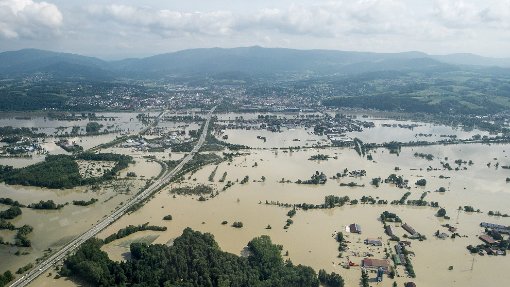
 http://www.abendzeitung-muenchen.de/gallery.hochwasser-aktuell-dresden-halle-deggendorf-jahrhundert-flut-so-schlimm-ist-die-lage-param~65~64~0~149~false.f29ba1fe-f2f1-457a-adee-162c8cb13de0.html

All that water eventually disperses, following natural water courses until it reaches the sea.  The main rivers in this area are the Elbe and the Danube.  For Kaiserswerth this is good news because of course we are on the Rhine.

However. . .

Melting snow in the Alps (where the Rhine is born); heavy rains in southern Germany (through which the Rhine runs), and some run off from the flooded areas, has meant that the Rhine too has risen.  This is view outside the old village walls, which you can just see on the right of this photo.  The trees grown on a little beach area by the river :


The Flood water (hochwasser) signs are out to prevent us taking the river path to nearby Wittlaer. . .


. . . And everyone wanders down to the river to see if it is getting 'too' high for our liking.  There is talk that the town flood barriers were to be prepared!


We often gauge the river's height by the angle of the gangway down to the pontoon for the Dusseldorf ferry.  It should run at roughly a 30 to 35 degree angle.  As you can see, that is not the case at the moment:


You should be able to walk to the marker, and on the far side of the river you can see that the ferry is staying where it is.  The river is too fast for it to make the journey to our side.


Mind you, it isn't as bad as it could be.  In 1926 the river rose 11 metres and Kaiserswerth was completely flooded.  The only way to move around was by boat:
This is the highest official recorded level of flooding in Kaiserswerth and you find markers all over the place showing how high the water reached once it entered the village; but in 1795 we are told it rose to 11.5 metres.
In 1993 and 1995 the river rose to at least 10 metres.
Thankfully in our time here I have not witnessed flooding to that extent, but we do get a rise in the water table when the Rhine is high.  This week we have had the old river bed near our apartment suddenly begin to fill with water:

The ducks love it of course and we have seen duckling floating about in the fields.  But it is not good for the horses and I read that coming at this time, the flooding has been particularly bad for the wild animals, with many nesting birds losing their eggs and young, and many baby animals drowning.
Here is another view of our rising water level.  This is the pathway that wends it way around the bushes  in the part of the old river bed below our apartment:

The fields are sodden and the grass (which the farm horses and cows would normally be frolicking in) is ruined:

Thankfully we are protected by our tree lined dykes.  The main dyke runs from Kaiserswerth, all the way into Dusseldorf; providing a stout barricade as well as a nice car-free path for walkers, joggers, and bike riders.  A smaller series of dykes protects our village.  Trees were planted on top to stabilize it.  Our own bijou apartment building sits atop the dyke too!

We feel that we are quite safe from any potential water threat.

Today when I checked the river I felt certain that it is receding...

Thursday, 30 May 2013

Meistertrunk: Rothenburg ob der Tauber

It has been an extremely busy few weeks for me with some major projects at work taking up a lot of my time.  Added to which I am still not over the bad cold which is making its presence felt in our community.  Now however the work is finished and the cold is on the way out, so I can get back to normal and do such pleasant things as cooking, relaxing, and reading my favourite blogs!
One welcome break from all the work was the long weekend that we had a couple of weeks ago.  The feast of Pentecost (in German: Pfingsten) is a religious holiday here in Germany and so the Monday (known in English as Whit Monday) is a public holiday.  We were doubly fortunate as our school had the Friday off as well which made for a nice four day weekend!

As we had visitors staying with us, we decided to  take them to Rothenburg, in southern Germany.

Rothenburg - or to be more precise Rothenburg ob der Tauber - is an ancient town that was once a Free City of the Holy Roman Empire.  The Thirty Year War and the Black Death were the end of Rothenburg's once proud and exalted status.  Defeated in battle and ravaged by the plague, the impoverished town stopped growing.  
Dilapidated and impoverished, the crumbling town was then 'discovered' by 18th and 19th Century tourists and it started to make a comeback, built upon its antiquated appearance.  
Its preserved state held a special appeal for the National Socialist Party in the 1930s, who looked upon it as an archetypal medieval German town (which it is) and decided to use it for their own ends.

As World War II drew to an end, the town was ordered to be defended at all costs but despite this, and thanks to some members of the American Military, who recognised it's historical importance, it was not like neighbouring Wurzburg, pounded into submission by aerial and ground bombardement.  At the same time. the German Commander, ignored orders and decided to surrender.  As a result thetown was saved although it had already received some serious damage resulting in loss of life.

Today Rothenburg is a major tourist destination and well worth a visit.

And so we sallied forth.

En route we stopped off at Burg Eltz, a medieval castle in the middle of a huge forest:

No photographs were allowed inside the castle buildings but these photos give you an idea of what it is like.  It really is like a fairy tale castle.  The visit was only marred by the fact that it rained - a lot!

Arriving in Rothenburg, the sky cleared up somewhat.  We were staying at a hotel called 'Die Goldener Hirsche' and after an early night we went to the breakfast room with its stunning views of the valley, and the town as it curves around the hill that it stands on:
(The above photographs are somewhat yellow due to the lighting as I was taking these through the breakfast room windows.)

We were last in Rothenburg a few years ago when we took my Mother there for the Christmas Market.  At that time the town looked like this:

No snow this time:
All sorts of rulers stayed at Rothenburg at one time or another:

These are called 'fachwerk' houses.  I guess that our equivalent would be 'Tudor style'


There are a lot of wonderful street signs:


And there is the Kathe Wohlfahrt shop, selling every imaginable thing you could associate with Christmas.  We naturally paid a visit:

One of the doors of the Town Hall.  I do like the door handle:


The town sits on a hill that curves around, almost like am amphitheatre.  Surrounded by its town wall, one end has been turned into a park.  We went there one evening to take photos and generally stroll about:
 The park used to be the castle of Rothenburg but it was destroyed by an earthquake in the middle ages!
 This is the memorial to the towns Jewish population who were killed in the pogrom in 1298.  

During the Thirty Year War, the area surrounding Rothenburg was the scene of much warfare.  The area was attacked by the invading Swedish army of the Protestant King, Gustav Adolf:


Areas changed hands many times as first the invading Protestant forces, and then the defending Catholic forces gained the upper hand.  Many legends are told about this time, often centre around the means by which various towns and villages were saved from being pillaged and destroyed by the conquering armies.
Rothenburg is no exception.  Count Tilly, the Imperial commander succeeded in taking Rothenburg and entering triumphantly into the town to be unexpectedly confronted by the mayor who offered him a drink.  The general accepted and then formulated a plan by which the town would be spared the ravages of his forces.  He announced that if someone would agree to drain a 6 pink tankard of beer (or it may have been wine) the town would be saved.  This sort of challenge was agreeable to the soliders.  The mayor took up the challenge, drained the tankard, and the town was saved!:
http://www.br.de/franken/inhalt/frankenkult-ur/meistertrunk106~_v-image512_-6a0b0d9618fb94fd9ee05a84a1099a13ec9d3321.jpg?version=1318861248198
This event, known as the Miestertrunk (Really Big Drink) is commemorated on the weekend of Pentecost, and so we were in the middle of it all!
The town was en fete with everyone dressed up in sixteenth century costume.  
This might seem overdone to the point of being somewhat kitsch, but it is done in such a natural way that it never seems that way.  The event takes place over the entire long weekend and after a while you feel as though you are living in the sixteenth century too!  People stroll about doing their shopping,  driving their cars, riding horses, eating in the restaurants, enjoying the sun, or just taking time out, but all dressed a la 16th Century.

There was lots of singing, marching, drinking and general bonhomie!

There is a lot of interesting things to see in Rothenburg ( and lots of shopping opportunities too) and perhaps I will write more about it at another time but to end this little tour of Rothenburg I am included some of the photographs I took, to give you an idea of what was 'going on'.  I hope you enjoy it!
This lot are just returning from a skirmish outside the town:
There we were enjoying our schweinhaxe (pork knuckle) or Hirschgulash (Venison Gulash) when some of the soldiers marched in and started singing for beer...
Pikemen getting ready to go out and defend the town:
 I like this photograph because one of the soldiers had a cigarette in one hand and something from the bakers' in the other: