|
| This Photograph was taken by Kirk Dale. |
Quedlinburg is situated in an area known as the Harz Mountains. Here, in former times, belief in witches was widespread and they were greatly feared. Not far away, near to the town of Thale, is the 'hexentanzplatz' (witches dancing place) where it was believed they met to plot and plan and I guess, to dance. The Quedlinburgers feared the witches and we were told that they covered their houses with numerous signs to ward them off. These can still be seen today, carved in to the woodwork:
 |
| This Photograph was taken by Kirk Dale. |
 |
| This Photograph was taken by Kirk Dale. |
 |
| This Photograph was taken by Kirk Dale. |
..............................
Interestingly, Quedlinburg is not just a 'mediaeval town'. It has some fine examples of the Art Nouveau (called Jugenstil in German). This front door is an example:
 |
| This Photograph was taken by Kirk Dale. |
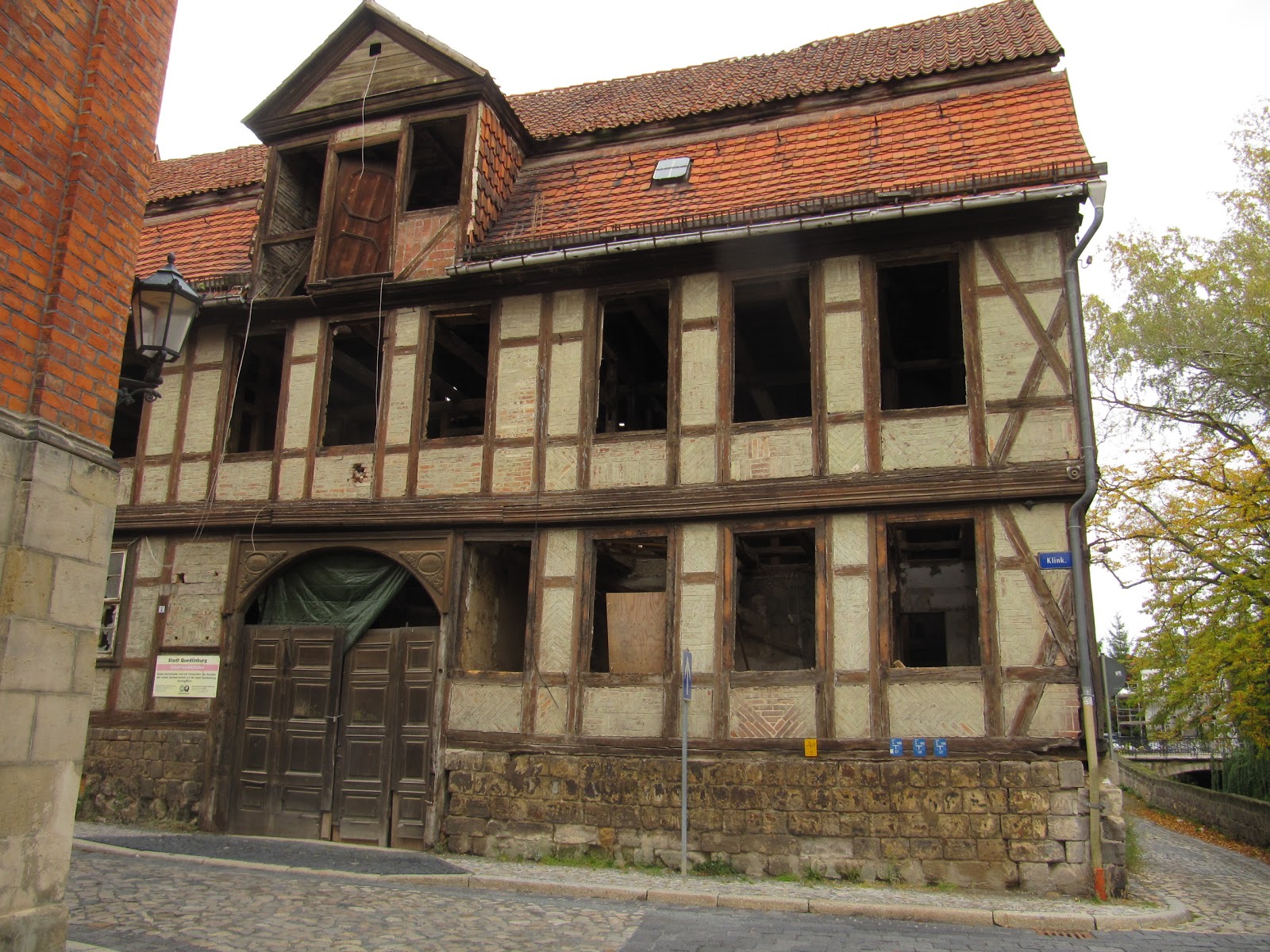
Meanwhile, at the rear of our hotel stands a large, old, house in a fairly typical Quedlinburger street. It was in a very sorry state. I would love to have been able to take it over, do it up and live in it!
 |
| This Photograph was taken by Kirk Dale. |
The outside of the house looked sturdy enough although a sign on the wall stated that it was marked for 'redevelopment':
 |
| This Photograph was taken by Kirk Dale. |
The inside had been gutted:
 |
| This Photograph was taken by Kirk Dale. |
The state of this house saddened me. I am sure it had an interesting history and situated as it was, beside one of the streams that flow through the town, it had a pleasant aspect. What a shame that it was sitting there, a shadow of its former self:
 |
| This Photograph was taken by Kirk Dale. |
We were busy walking about and exploring the old town when joy of joys, just around the corner from a mustard shop, I spotted a large amount of conkers just waiting to be collected:
 |
| This Photograph was taken by Kirk Dale. |
I picked five or six and with them safely in my pocket we went for a rather pleasant meal at a local restaurant. After that it was time for bed, having had a full and rather interesting day.
Our second morning in Quedlinburg saw blue skies and the sun shining down upon us all:
 |
| This Photograph was taken by Kirk Dale. |
Having settled our account we took our bags to the car and then went for a last walk around. We had a mission in mind: to visit the castle/palace and the abbey church, both of which sit high on a hill overlooking the old town:
 |
| This Photograph was taken by Kirk Dale. |
It was here at Quedlinburg, according to legend, that Henry of Saxony, nicknamed 'the Fowler', was offered the crown of Germany in about the year 919. A plaque on one of the houses commemorates this event:
 |
| This Photograph was taken by Kirk Dale. |
When Henry died his wife Matilda (St. Matilda of Ringelheim) asked his successor to grant her the land now known as Quedlinburg so that she could build a royal abbey there to serve as Henry's sepulchre. This request was granted and the resulting buildings are here for us to view today. This is the palace:
 |
| This Photograph was taken by Kirk Dale. |
From that point on, Quedlinburg was ruled by a series of abbesses, starting with St. Matilda herself. She would later be buried there, at the side of her husband. After the Reformation in Germany, the role of abbess was taken on by various protestant princesses, although their role was secular rather than overtly religious. As a result the convent was transformed into a palace of some splendour. This one of the Drawing Rooms within the palace, containing a selection of what is termed 'Biedermeier' furniture:
 |
| This Photograph was taken by Kirk Dale |
I am rather partial to chandeliers. I could easily have taken this one home with us:
 |
| This Photograph was taken by Kirk Dale. |
Here is a shoe belonging to one of the later secular abbesses of Quedlinburg:
 |
| This Photograph was taken by Kirk Dale. |
And here is a page from one of the books on display showing a Dodo and an 'Indian Pig' which looks to me like a guinea pig:
 |
| This Photograph was taken by Kirk Dale |
This rather nice settle caught our eye:
 |
| This Photograph was taken by Kirk Dale. |
As did this empire day bed:
 |
| This Photograph was taken by Kirk Dale. |
From the palace we moved on to the abbey church:
 |
| This Photograph was taken by Kirk Dale. |
The abbey church sits opposite the palace, separated by a small courtyard.
In the 1930s it became somewhat infamous due to the nefarious activities of Heinrich Himmler and the National Socialist Party. If I understand things correctly, Himmler secretly believed himself to be the reincarnation of Henry the Fowler and decided to raise him up for the people as a sort of German ideal, because he had subjugated the Slavic peoples of the time. Wanting to go one step further, Himmler and his associates made plans for the eradication of Christianity within Germany. This would then be replaced by a new religion centred around the National Socialist Party. Quedlinburg was to become the headquarters for all this and in preparation, the Lutheran clergy were evicted and old Henry's body was disinterred, then reburied with all the paraphernalia that accompanied the National Socialist Party and its stark beliefs. The War however interrupted these plans and once it was over, the Lutheran Church once again took control of the site and Henry was once again disinterred and then reinterred. I am not sure what happened to St Matilda during all this carry-on but within the abbey crypt is a very interesting exhibition that documents it all. Interestingly Himmler's tomb was not totally destroyed but rather broken up, along with the eagle emblem that accompanied it, and retained for posterity:
Here is the 'Himmler' tomb, with the lid broken asunder:
 |
| This Photograph was taken by Kirk Dale. |
And here is the National Socialist eagle, also broken up, while one of their candlesticks has been wrapped in barbed wire:
 |
| This Photograph was taken by Kirk Dale. |
Should these National Socialist 'relics' have been kept or destroyed utterly? At first I felt affronted that the old king's remains should had been treated in such a way by Himmler, but then I reasoned that it is good that such things are kept, to show posterity the lengths that dictatorships can go to. Plus, it all forms part of the history of this place - both the good and the bad.
The interior of the abbey church itself is rather barren but it does have a very nice museum that contains the abbey treasures including some things that had been stolen by an American serviceman at the end of World War II and only recently returned. No photographs were allowed but on display is a 1st Century alabaster urn said to have been used by Our Lord to turn water in to wine at the Wedding of Cana! Here is the Church interior:
 |
| This Photograph was taken by Kirk Dale. |
I did like this door handle, cleverly fashioned into a curly-tailed dog jumping through a hoop:
 |
| This Photograph was taken by Kirk Dale. |
The site makes for some nice photographic opportunities as we looked back down on Quedlinburg:
 |
| This Photograph was taken by Kirk Dale. |
The old part of Quedlinburg, together with the abbey church and the palace, is a UNESCO World Heritage site. It is easy to see why.
 |
| This Photograph was taken by Kirk Dale. |
 |
| This Photograph was not taken by Kirk Dale, it was taken by AGA. |
There was just time for some short reflection on what we had seen before we were back in the car and off on the next leg of our journey - but more of that later. . .
I hope you enjoyed this second part of our journey to Quedlinburg! I have tried to give you a flavour of what it is like to visit.