Showing posts with label Sightseeing. Show all posts

Monday, 5 November 2012

The Horseman, St. Otto, and the Heavenly Garden.

This is my last post on our motoring holiday into Germany otherwise you will be thinking: "Not more holiday photos!!!  When will it all end!?"
So,
When we visited Bamberg, two sites made a huge impression upon us.  I would like to share them with you.  The first one is Bamberg Cathedral.

Bamberg Cathedral celebrates its 1,000 anniversary this year.  It is a big old church with (I think) copper roofing on its four towers that has gone green with age.
This Photograph was taken by Kirk Dale.
The outside of this building is adorned with architectural treasures that are a joy to behold:
This is one of the side portals to the Cathedral.  The scene above the doorway shows the Final Judgement.  Sinners on Our Lord's left and saved on His right:
This Photograph was taken by Kirk Dale.
 Here is a close-up.  I like the fact that one finds all sorts among both sinners and saved.  The sinners grimace in terror as a devil hauls them off, while the saved smile beatifically:
This Photograph was taken by Kirk Dale.
Here are the sculptures above the main portal.  Our Lady and the Infant Jesus are with St Peter and St George:
This Photograph was taken by Kirk Dale.
Another portal shows the various Saints associated with the Cathedral:
This Photograph was taken by Kirk Dale.
St Stephen the Martyr, St. Kunigunde and St. Henry are on the left, while St Andrew and Adam and Eve are on the left.  These are not the original medieval statuary.  They are to be found within the Diocesan museum, having aged somewhat badly, however these are exact replicas.  Here is a detail of St. Kunigunde and St. Henry:
This Photograph was taken by Kirk Dale.
And here are Adam and Eve with the appropriate leaves.  You will see that the replicas lack arms hands and other parts.  This is the condition of the medieval originals and the replicas are modelled similarly:
This Photograph was taken by Kirk Dale.
Once inside the Cathedral there are more treasures to behold.
This Photograph was taken by Kirk Dale.
This is a late Medieval statue of Our Lady and the Infant Jesus:
This Photograph was taken by Kirk Dale.
And here is the famous thirteenth century sculpture: The Bamberg Horseman:
This Photograph was taken by Kirk Dale.
Some people think that it represents St Stephen of Hungary, others say it is the Emperor St. Henry while still others say it is a chap called Conrad.  No one really knows for certain and it all just guess work really.
Putting that to one side though, it looks as if the statue were carved recently rather than nearly eight hundred years ago, but I guess this is due to the fact that it is inside, high up, and out of the elements.

Here is the tomb of the royal Saints: the Emperor Henry II and the Empress Kunigunde; founders of the Cathedral.  The tomb was carved in the 1500s by the famous sculptor, Tilman Reimenshneider.  I have seen another work of his: a huge altar piece in the church at Rothenburg ob der Taube.  In the crypt one can see the skulls of the two Saints however as these are Holy Relics I did not take a photograph.
This Photograph was taken by Kirk Dale.
And here, on the side of the tomb is carved the Empress Kunigunde walking barefoot across red hot plough shares before the Emperor, to prove her innocence when accused by the cathedral workmen (who didn't like the way she was bossing them about when it came to finishing the Cathedral buildings) of being unfaithful to the Emperor in his absence:
This Photograph was taken by Kirk Dale.
 Here is a prosperous Prince Bishop of Bamberg giving his blessing:
This Photograph was taken by Kirk Dale.
Here, just behind the current Archbishop of Bamberg's throne, is the tomb of Pope Clement II, the only Pope buried in Germany.  This is a restricted and sacred area, being the High Altar, and as such off limits to wandering tourists, so I have taken a photograph using the zoom lens:
This Photograph was taken by Kirk Dale.
And finally here is a statue of poor old Saint Denis, bishop of Paris, who had his head cut off during a Christian persecution in about 250.  A popular saint in medieval times:
This Photograph was taken by Kirk Dale.
I really liked this cathedral.  It has gone through a lot not the least being the 'modernization' undertaken by an interfering 19th Century King of Bavaria (when much medieval painting was lost forever) and yet it retains a sense of dignity and gentleness that I found palpable.

The second place I would like to show you is the Michaelsberg Abbey:
Here it is bathed in autumnal sunlight.  It sits on its own hill and until secularization in 1802 was a prosperous monastery.
This Photograph was taken by Kirk Dale.
There are two treasures within this building:
The first is behind the High Altar which in itself is a thing of beauty:
This somewhat blurred Photograph was taken by Kirk Dale.
If you walk around the altar you come across a small room in which you find the tomb of St Otto of Bamberg.  St Otto (known as Otto the Good) died in the year 1139 and was later recognised as a saint.  Here is his tomb:
This Photograph was taken by Kirk Dale.
St Otto is a Saint who looks after you if you have back ache (a problem that both AGA and I were suffering from, thanks to long hours of sightseeing).
If you crawl through the hole in the tomb, making a true and pious request, St Otto will cure you of back ache.  Well it isn't very scientific I know but AGA and I are Catholics and so we 'did' it.  There are no photographs as the process is somewhat ungainly, however we took it in turns to crawl through the hole and, I kid you not, our backs did not ache for the rest of the trip!
So thank you St Otto the Good!

The other treasure of the Michaelsberg Abbey is the Heavenly Garden; the painted ceiling of the Abbey Church.  Here it is:
This Photograph was taken by Kirk Dale.
Undertaken in the early part of the seventeenth century, it contains many, many paintings of flowers, trees, and other plants.  There is even a cactus and a pineapple plant (I thought I had taken a photograph of this but find that I did not, so I can't show you).  
The ceiling is awe-inspiring.  Wouldn't you agree?
This Photograph was taken by Kirk Dale.
Here is a close up.  You can see a Turk's Cap Lily amongst the floral delights:
This Photograph was taken by Kirk Dale.
And here is an even closer look.  This foxglove is a work of art.  You know exactly what you are looking at.  Correct in all details, I could have spent all day looking at these little gems!
This Photograph was taken by Kirk Dale.
 Here is one more. I am fairly sure it is a geranium although I may be wrong:
This Photograph was taken by Kirk Dale.
What I particularly like is the care and attention to detail taken by the artist, even though most people among the congregation would not notice the finer points because they were too far away for the eye to see.  And yet how often do we look at a flower but not really 'see' it?  Often we merely gain an impression before moving on to something else.  To have the ability to paint flowers, and to paint them with such detail - that is a talent I wish that I had!

Well, I hope you enjoyed this post.  I am glad that I have been able to share with you these two cultural and artistic wonders!

And just before I go I feel I must show you one more thing: The Bamberg Tickler...
This Photograph was taken by Kirk Dale.
This sculpture is over the entrance to the old Bishop's Palace.  It shows a 'wild woman' reclining on the ground.  A cherub or some such thing is doing something to her toe and I read where he is supposédly tickling her!  Here is a close up:
This Photograph was taken by Kirk Dale.
It certainly looks as though he is tickling her, either that or he is pinching her!

Friday, 2 November 2012

Bamberg anyone?

The reality of my working life came crashing in upon me this last week.  
There was such a lot to do as a result of the conference I attended!  No time could be given over to the pleasures of writing another post.
But now all is under control and I am free once more.

Speaking of the conference, it was in Budapest and while I was there I was able to take up a kind offer proffered by Jane and Lance Hattatt.  I spent a rather pleasant evening attending a dinner party at their lovely residence in the heart of the City.
It was nice to meet people with whom I felt instantly at home.  Their other guests - R, W, H and B -  were equally charming people and most welcoming to me, a stranger within their midsts.  I hope to return to Budapest in more leisurely circumstances, at a later date and with AGA in tow, to 'see the sites'.

* * * * * * *

So anyway, there we were in Quedlinburg; but our holiday didn't end there, and after a couple of days we decamped and motored south.
The journey there was made amidst the wonders of a perfect autumn day.  The sky was bright and the colours were wonderful!
This Photograph was taken by Kirk Dale.
And so at length we approached the city of Bamberg.


Have you been there?

It is well worth a visit, as you shall see.


This photograph of Bamberg was taken by Kirk Dale.  The cathedral is in the middle of the photograph but I have no idea who that person is in the foreground.
Getting into Bamberg proved to be something of a challenge thanks to its unusual, and most extensive one way street system that encompasses both old and new town.  After having been lost for a good half an hour I decided that the only course was to ask a policeman.  Spotting a police station I drove in and while AGA waited in the car I went inside and met my first German Police Sergeant: An extremely helpful man who printed out a map and then drew direction so that we should not get lost again.  When I got back to the car AGA pointed out that the two undercover 'cops' that I thought the sergeant had been speaking to prior to assisting me, were in fact the gardeners...  However it had still been an exciting experience and so, accompanied by Christoph Willibald Gluck, Iphigénie, Oreste, Pylade, King Thoas and the rest, (directed by the incomparable Marc Minkowski) we came rollicking dramatically into the fair city late in the evening.  

A late dinner and then to bed.

The next morning we breakfasted and then set off to explore the town.

Quedlinburg had been a fairly well-to-do town and was at its peak during the Middle Ages after which a lack of money meant that not much in the way of new building took place and the town remained fairly much unchanged.
Bamberg on the other hand had always been a prosperous place, ruled over by a Prince-Bishop, and until 1803 was an independent city.  It contains palaces, magnificent churches and monasteries, a well endowed university and wonderful streets filled with fabulous houses.  I would call it a Baroque city myself.
Please allow me to show you around...

This building is the Altenburg, a castle built on one of the seven hills upon which Bamberg stands.  This view is from our hotel balcony and while I admit that I used the camera zoom, it was still close enough to walk to:
This Photograph was taken by Kirk Dale
This is a view of the old St Michael's monastery.  It sits on another hill: The Michaelsberg.
This Photograph was taken by Kirk Dale.
Here is the 'centre' of town.  The old Town Hall is the building in the middle of the photograph.  It is actually on an island and you get to it via a grand bridge:
This Photograph was taken by Kirk Dale.
 Built in the 14th Century, it now houses a museum containing an impressive collection of porcelain  (mostly Meissen) known as the 'Ludwig Collection'.  It includes these lovelies!
This Photograph was taken by Kirk Dale.
 This tulip vase:
This Photograph was taken by Kirk Dale.
 And this very nice tureen:
This Photograph was taken by Kirk Dale.
Here on the outskirts of the old town of Bamberg lies 'Little Venice'.  Each house fronts the river:
This Photograph was taken by Kirk Dale.
Here is the Cathedral of Bamberg.  This year (2012) marks the 1000th anniversary of its founding.  There was a very interesting exhibition within the Diocesan Museum, which AGA and I visited.  The treasures of the Cathedral are include many early medieval garments such as the robes of St Kunigunde and the only existing robes of an early medieval Pope (these were owned by Pope Clement II who lies buried within the cathedral).  Unfortunately no photographs were allowed within the museum. 
This Photograph was taken by Kirk Dale.  It looks rather dull but I am not sure why - probably the fault of the so called Photographer!
Opposite the Cathedral is the New Residence (Neue Residenz) which was home to the Prince Bishops and later served as a home for the exiled King Otto of Greece and his wife.  I never knew much about him but the museum within expanded upon his life and he sounded like a very nice man.  Here is a detail of this very, very large building:
This Photograph was taken by Kirk Dale.
And here is as much of it as I could get into a photograph:
This Photograph was taken by Kirk Dale.
Bamberg is renowned for its breweries.  There are eight of them, one of which is a restaurant as well.  The large coppery brewery vats are set amongst the tables.  I am rather partial to a glass of beer or two and so I was able to try a different type of beer each night we were there:
This Photograph was taken by Kirk Dale.  AGA is holding the glass to give an idea of size.
And while we are on the subject of eating and drinking I should add that we ate a lot of rather delicious Franconian cooking such as this schwein haxe (pork knuckle) with potato dumplings.  I enjoyed it but didn't care for the green mush.  It smelt and tasted like cabbage. . . blech!
This Photograph was taken by Kirk Dale.
 And then there were the cinnamon apple fritters with ice-cream and cream:
This Photograph was taken by Kirk Dale.
Here is another view of the old town centre.  The old Town Hall is on the right.  It really was a very charming spot, and that white house on the left had a lovely book shop on the ground floor facing the street.  We made a couple of purchases there and the lady said she would look after our bags while we continued to explore.  Later I noticed that the house had a lovely garden that bordered the river and I wondered whether the lady lived there.  I hope so:
This Photograph was taken by Kirk Dale.

Bamberg has some very interesting buildings but I will show them in another post as I don't want this one to be too long!  I shall therefore end with this photograph of some brave roses who remained in bloom even though the chill of winter was in the air:
This Photograph was taken by Kirk Dale.
Here is an update for you: It consists of one more photograph.  I am putting this in for Mark Ruffner. who liked the look of it.  The ornate part of the old Town Hall is actually the archway for passing across the bridge. It forms the entrance to the Council Chambers which occupy this building, as well as the space over the arch:

This Photograph was taken by Kirk Dale.

Sunday, 21 October 2012

Visiting Q'burg (part two)

This Photograph was taken by Kirk Dale.
Quedlinburg is situated in an area known as the Harz Mountains.  Here, in former times, belief in witches was widespread and they were greatly feared.  Not far away, near to the town of Thale, is the 'hexentanzplatz' (witches dancing place) where it was believed they met to plot and plan and I guess, to dance.  The Quedlinburgers feared the witches and we were told that they covered their houses with numerous signs to ward them off.  These can still be seen today, carved in to the woodwork:
This Photograph was taken by Kirk Dale.
..............................

Interestingly, Quedlinburg is not just a 'mediaeval town'.  It has some fine examples of the Art Nouveau  (called Jugenstil in German).  This front door is an example:

This Photograph was taken by Kirk Dale.
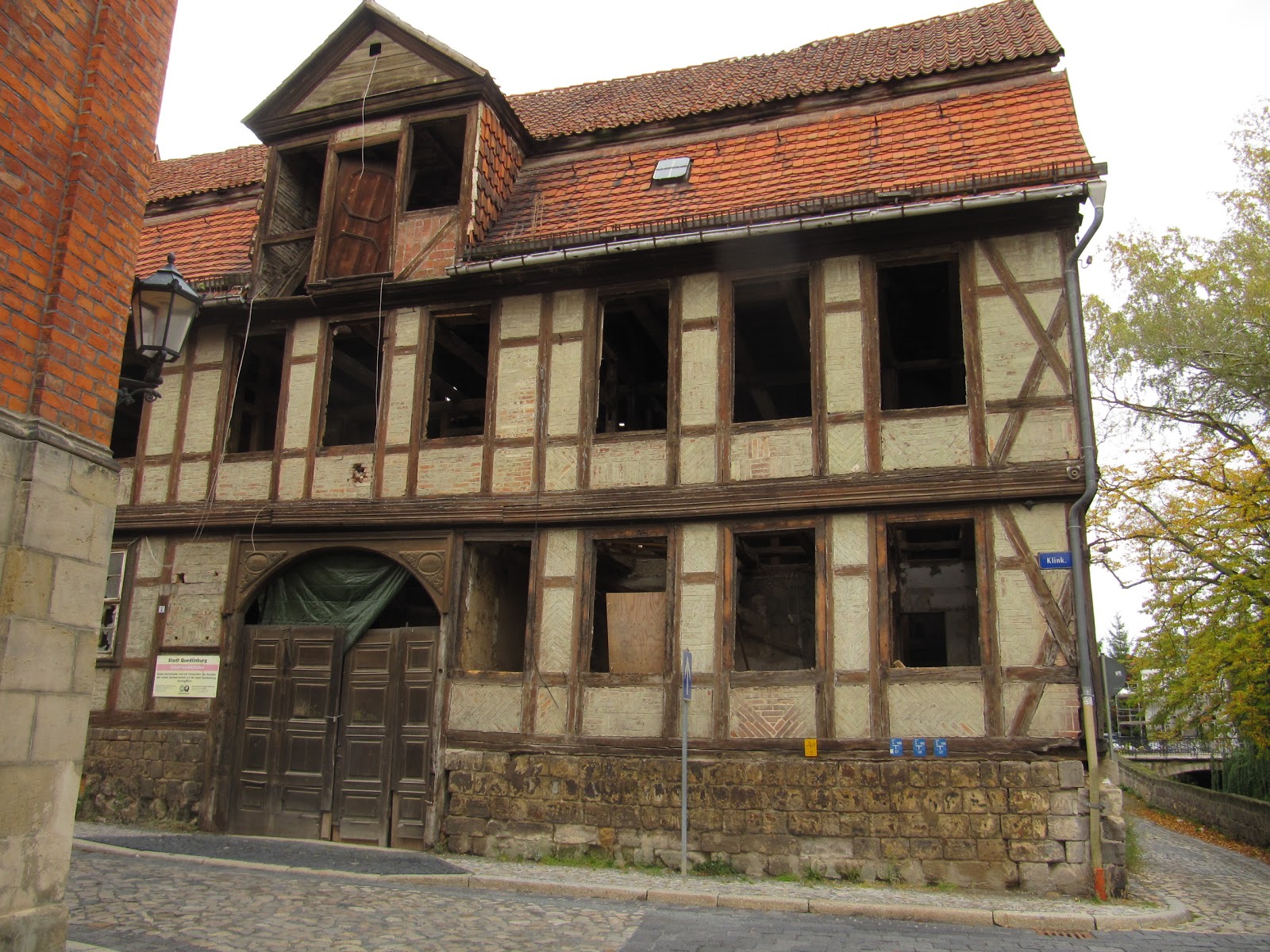
Meanwhile, at the rear of our hotel stands a large, old, house in a fairly typical Quedlinburger street.  It was in a very sorry state.  I would love to have been able to take it over, do it up and live in it!
This Photograph was taken by Kirk Dale.
The outside of the house looked sturdy enough although a sign on the wall stated that it was marked for 'redevelopment':
This Photograph was taken by Kirk Dale.
 The inside had been gutted:
This Photograph was taken by Kirk Dale.
The state of this house saddened me.  I am sure it had an interesting history and situated as it was, beside one of the streams that flow through the town, it had a pleasant aspect.  What a shame that it was sitting there, a shadow of its former self:
This Photograph was taken by Kirk Dale.
We were busy walking about and exploring the old town when joy of joys, just around the corner from a mustard shop, I spotted a large amount of conkers just waiting to be collected:
This Photograph was taken by Kirk Dale.
I picked five or six and with them safely in my pocket we went for a rather pleasant meal at a local restaurant.  After that it was time for bed, having had a full and rather interesting day.

Our second morning in Quedlinburg saw blue skies and the sun shining down upon us all:
This Photograph was taken by Kirk Dale.
Having settled our account we took our bags to the car and then went for a last walk around.  We had a mission in mind: to visit the castle/palace and the abbey church, both of which sit high on a hill overlooking the old town:
This Photograph was taken by Kirk Dale.
It was here at Quedlinburg, according to legend, that Henry of Saxony, nicknamed 'the Fowler', was offered the crown of Germany in about the year 919.  A plaque on one of the houses commemorates this event:
This Photograph was taken by Kirk Dale.
When Henry died his wife Matilda (St. Matilda of Ringelheim) asked his successor to grant her the land now known as Quedlinburg so that she could build a royal abbey there to serve as Henry's sepulchre.  This request was granted and the resulting buildings are here for us to view today.  This is the palace:
This Photograph was taken by Kirk Dale.
From that point on, Quedlinburg was ruled by a series of abbesses, starting with St. Matilda herself.  She would later be buried there, at the side of her husband.  After the Reformation in Germany, the role of abbess was taken on by various protestant princesses, although their role was secular rather than overtly religious.  As a result the convent was transformed into a palace of some splendour.  This one of the Drawing Rooms within the palace, containing a selection of what is termed 'Biedermeier' furniture:
This Photograph was taken by Kirk Dale
 I am rather partial to chandeliers.  I could easily have taken this one home with us:
This Photograph was taken by Kirk Dale. 
Here is a shoe belonging to one of the later secular abbesses of Quedlinburg:

This Photograph was taken by Kirk Dale.
And here is a page from one of the books on display showing a Dodo and an 'Indian Pig' which looks to me like a guinea pig:
This Photograph was taken by Kirk Dale
 This rather nice settle caught our eye:
This Photograph was taken by Kirk Dale.
 As did this empire day bed:
This Photograph was taken by Kirk Dale.
From the palace we moved on to the abbey church:
This Photograph was taken by Kirk Dale.
The abbey church sits opposite the palace, separated by a small courtyard.
In the 1930s it became somewhat infamous due to the nefarious activities of Heinrich Himmler and the National Socialist Party.  If I understand things correctly, Himmler secretly believed himself to be the reincarnation of Henry the Fowler and decided to raise him up for the people as a sort of German ideal, because he had subjugated the Slavic peoples of the time.  Wanting to go one step further, Himmler and his associates made plans for the eradication of Christianity within Germany.  This would then be replaced by a new religion centred around the National Socialist Party. Quedlinburg was to become the headquarters for all this and in preparation, the Lutheran clergy were evicted and old Henry's body was disinterred, then reburied with all the paraphernalia that accompanied the National Socialist Party and its stark beliefs.  The War however interrupted these plans and once it was over, the Lutheran Church once again took control of the site and Henry was once again disinterred and then reinterred.  I am not sure what happened to St Matilda during all this carry-on but within the abbey crypt is a very interesting exhibition that documents it all.  Interestingly Himmler's tomb was not totally destroyed but rather broken up, along with the eagle emblem that accompanied it, and retained for posterity:
Here is the 'Himmler' tomb, with the lid broken asunder:
This Photograph was taken by Kirk Dale.
And here is the National Socialist eagle, also broken up, while one of their candlesticks has been wrapped in barbed wire:
This Photograph was taken by Kirk Dale.
Should these National Socialist 'relics' have been kept or destroyed utterly?  At first I felt affronted that the old king's remains should had been treated in such a way by Himmler, but then I reasoned that it is good that such things are kept, to show posterity the lengths that dictatorships can go to.  Plus, it all forms part of the history of this place - both the good and the bad.

The interior of the abbey church itself is rather barren but it does have a very nice museum that contains the abbey treasures including some things that had been stolen by an American serviceman at the end of World War II and only recently returned.  No photographs were allowed but on display is a 1st Century alabaster urn said to have been used by Our Lord to turn water in to wine at the Wedding of Cana!  Here is the Church interior:

This Photograph was taken by Kirk Dale.
I did like this door handle, cleverly fashioned into a curly-tailed dog jumping through a hoop:

This Photograph was taken by Kirk Dale.
The site makes for some nice photographic opportunities as we looked back down on Quedlinburg:
This Photograph was taken by Kirk Dale.
The old part of Quedlinburg, together with the abbey church and the palace, is a UNESCO World Heritage site.  It is easy to see why.
This Photograph was taken by Kirk Dale.
This Photograph was not taken by Kirk Dale, it was taken by AGA.
There was just time for some short reflection on what we had seen before we were back in the car and off on the next leg of our journey - but more of that later. . .

I hope you enjoyed this second part of our journey to Quedlinburg!  I have tried to give you a flavour of what it is like to visit.