Showing posts with label Strolling about with fixed intent. Show all posts

Sunday, 22 September 2013

Dreams broken, and dashed asunder!

Far away, on the Leicestershire/Northamptonshire borders, far away from roads and indeed, any hint of the 21st Century, you might (if you are lucky) come across this green, tree-lined lane:

  
This lane is not made for striding along in stout walking books.
A gentle amble is all that is required.
At the end of the lane is, what appears at first to be, a stream:

Closer inspection reveals it to be a moat of sorts, surrounding a greenish hill: no castle is to be seen, but it is definitely manmade.

Is this some sort of fairyland?

To some extent the answer is 'yes' and this is only reinforced as one leaves the moat behind and strolls past a meadow filled with wild flowers:


One feels a part of nature - but is it really?  Is this nature in the raw - or an idyll?  A tamed and civilised nature - a heavenly nature?

There is certainly enchantment here...

Suddenly, one notices a relatively ordinary looking, old house which is only made extraordinary by the fact that it is seemingly sitting in the middle of nowhere. . .
Do these fields; the green and pleasant lane; the moat, all belong to this fairly ordinary house?
(And who lives in there?)

But all thoughts of the house and it's occupants are forgotten when one notices what is standing behind it: A palace worthy of a fairytale!!
Lyveden New Build - a place of dreams broken and dashed asunder.

Lyveden New Build (or as the National Trust puts it 'Lyveden New Bield')

Lyveden looks like  a house in ruins but in fact it is a structure 'frozen' in mid construction.

It may look like a grand house but in truth it is 'only' a lodge; conceived and built by Sir Thomas Tresham.  
It was called New Build to distinguish it from the old Lyveden, the family home of the Treshams.  
The New Build was designed as a place to retire to from the hurly burly of life on a large sheep farming estate.  It would be to this spot that Sir Thomas, his family and intimate friends could retire and be away from it all.

Sir Thomas Tresham was a fashionable, socially well-contacted, Elizabethan courtier from a wealthy family.  
Old money. 
Old religion.  
In this new Protestant kingdom, Thomas and those like him stood out for their Catholic adherence. At first a Catholic who outwardly conformed to the new order of things, he suddenly rebelled and began refusing to go to the Protestant Church services.  The Government were used to this sort of thing and had the perfect remedy: Lengthy Prison terms and heavy fines.  This was to be Thomas' lot in life.  The chains that would eventually overcome his dreams.

The application of those fines would gradually meant an ever increasing dint in his wealth; but at first Thomas was able to absorb such losses.  Sheep farming was his major source of wealth.  Wool production provided him with a steady income. But Sir Thomas's purse was not bottomless and eventually those fines, combined with a very generous lifestyle,  and a total of fifteen years in prison  - at his own expense - had the effect of slowly beggering the once wealthy family.  But that was in the future.  We are at Lyveden, begun when Sir Thomas was feeling more financially secure...

The front door at Lyveden

When Sir Thomas set his hand to something, he seems to have given it his all.  He had already dabbled in design, having draw up plans for the triangular-shaped Rushton Lodge (in the same County).  That building had been constructed based upon certain principals which Sir Thomas expanded upon with Lyveden.  

It was a slow process and by 1605 the stonework of the basement, the ground and the first floors of Lyveden were all constructed.  The materials for the second floor had been collected and . . .

But there was no more 'and'.  

Sir Thomas died.

His son and heir Francis was suddenly caught up in the gunpowder plot, dying 'mysteriously' in prison in the same year.

Everything fell in a heap.

Thomas had had to provide wedding dowries for his six daughters.  This together with the huge fines imposed upon him by the government meant that he died with his estate in significant debt.
The disgrace and death of his heir, leaving a child to inherit the impoverished lands meant that at that moment there was no money to pay the workmen, and there was unlikely to be any for some time to come.  Their response was to cut their losses, pick up their tools, and leave.

And that, for the most part, was that.

Lyveden New Build remained trapped.
Unfinished.

Any interior wooden structures have either rotted away or were carted off for other purposes and apart from a minor incident in the Civil War that could have led to it's destruction but didn't, Lyveden has stood frozen in time.   The building was sturdy, well constructed and able to withstand the elements, even in its unfinished state.
And thus it remains until this day
(Which is nice actually because it is now owned by the National Trust and you can visit it yourself!)


This is a photo of some interior carves stone ceiling work.  It is a typical late Renaissance pattern, similar to that which can be seen at Burghley, home of Sir Thomas' political enemy (and Elizabeth's chief councillor, William Cecil):

I took this photo at Burghley House but forgot to 'picmonkey' it 

But why visit?  Why did I make the journey to go and see it?

It 'appears' to be a half-finished lodge, standing in the middle of a field but there is oh so much more to Lyveden than that!


Symbolism was very fashionable in the Elizabeth era.  
Hidden meanings: It was a very Renaissance 'thing'.
Almost everything could stand for something else and entire books were composed on the subject.   Secret codes.  Secret messages.  The Renaissance mind love it!  
The colours you wore; the jewellery and embroidery with which you adorned yourself; the statuary; the carvings on your house; the very flowers you chose to have in your garden:  All were ways of making a statement without actually being seen to make one.
Take for example this famous portrait of Queen Elizabeth I:  The so-called Rainbow Portrait:

http://en.wikipedia.org/wiki/File:Elizabeth_I_Rainbow_Portrait.jpg
Eyes, ears, a rainbow, pearls: the painting is adorned with symbolism.  Sometimes we think we know what the symbols mean but we could well be quite wrong.  Sometimes we have no idea what the 'message' is.

Lyveden is building full of symbolism

Sir Thomas conceived the idea of Lyveden Lodge after his volte face on the issue of his outward conformation to Government diktats.  The lodge was to be a symbol of his return to his Catholic roots in the face of increased government persecution. It would proclaim to one and all where his sympathies lay.

As you can see from this aerial view, Lyveden was built in the form of a Greek Cross:

http://www.northamptonshiretouristguide.com/Articles/Article_57.asp

A Greek Cross has four arms of equal length, and this is the basic layout of the building.  This meant that the building could consist of five equal squares of which you will read more later.

Sir Thomas then directed that certain symbols were to be carved on the outer surfaces of Lyveden.  These symbols were to not only make a statement about the owner but were to illustrates the mystical nature of the building.
Here are some examples:
In the main photo below is the Chi Rho sign. Top right is Our Lord's robe and the dice that the guards used for gambling to see who would get the robe after He died.  The lower right photographs shows some of the letters carved into the stonework.  In the bottom right is part of the Latin inscription that ran around the first floor.  It consists of various statements in Latin, taken from the Bible.  This part reads in full (and I have highlighted in red the part you can see) : 
J E S U S. B E A T U S. J V E N T E R. Q V I. T E. P O R T A V I T.  
In English: Jesus, Blessed is the womb that bore thee.

In this second collage you have: Main photograph, the sacred IHS (which can mean Iesus Hominum Salvator (Jesus Saviour of the World) or In Hoc Signo (In this sign you will conquer).  It was also the symbol for the Order of Jesuits (the bête noire of the English Government).  The upper right shows the ChiRho sign again, plus a bag symbolising the money paid to Judas for betraying Jesus. The thirty silver coins are carved as a ring around the bag.  The middle photograph shows the instruments of torture used on Jesus.  The bottom photo shows more of the same.

All these symbols refer to suffering, the overcoming of suffering, and the persecution the government was carrying out against those who maintained the 'old religion', people like Sir Thomas.  No wonder he was a government target!


Sir Thomas was a very clever man and even from his prison cell he directed his building operations.  He used special numbers when designing Lyveden: Three to represent the Holy Trinity; Five to represent the Five Wounds of Christ, and Seven to represent the seven instruments of the Crucifixion.
Here is a quote from the National Trust Guide Book:
"The plan of New Build consists of five equal squares.  Each arm of the Cross ends in a bay with five sides, each measuring five feet, making a total of twenty-five feet.  This is no accident - the 25th is the date both of the Nativity (December) and the Annunciation (March)...
"The lodge is on three floors (but the second floor was never built)  . . . Outside, sets of three shields are divided by three windows, diamonds are grouped in threes and the measurement from one side of the building to the other is 243 feet - three x three x three x three x three.
I find these sorts of things both fascinating and very clever.


The audio guide told me that this niche probably held the Statue of Our Lady owned by Sir Thomas's wife (and usually hidden from the government who would have destroyed it).
In those days, after the death of her husband and son, (and the wooden floor and rudimentary ceiling still existed) she sometimes came here with a few select followers to meditate and pray:


Tourists throughout the ages have visited Lyveden and some have left their mark:


The interior gives us hints as the plans Sir Thomas had for the finished product.  What a wonderful place it would have been!


One sees everything from the basement level because of course there is no flooring although the holes for the joists still exist.  In one part of the complex however, one can mount a platform and look out of the upper floor windows, across the fields. In Sir Thomas' days these fields were home to his extensive herds of sheep:


Lyveden is not a big place.  A visit, even with an audio guide, doesn't take much time. Indeed many people come and go within half an hour!

The building is undoubtably beautiful.  The stone turns almost honey-coloured in the afternoon light, and the very green grass at this time of year only goes to accentuate this beauty:


But beauty is not the real reason for visiting Lyveden.  Nor is the fact that you can tick off (on your list) another National Trust property visited.

Rather, the reason for visiting Lyveden is to be found in the site itself, the atmosphere, and the spirit of the man who built it.
These are the things that drew me to visit this unfinished diamond.  I find that there is a sense of dignified sadness about the place.
What dreams Sir Thomas must have had when first he conceived of building this 'little' lodge for himself.


I hope you enjoyed this little tour.  If you have not been there already, I recommend you hot-foot it there as soon as possible!

Monday, 16 September 2013

We've been a while a wandering!

Among the leaves so green.


When one takes 'time off', one is apt to get rather carried away.

Time becomes . . . almost . . . irrelevant . . .

One look at one's watch and exclaims: Is that the time? 4 o'clock already?  Time for tea!

I ask AGA what day it is and when we have looked at the newspaper and obtained the answer, we are amazed that a week has seemingly flown past, spent in idle, silken, luxuriousness!

And so, it is with some surprise that I realise that it has been over two months since I have visited my bijou blog residence!!

Mind you, we have not really been idle...

We have been frolicking in the countryside:


We have indulged in truly delicious beers:

(I should say 'I' as AGA doesn't care for beer...)

We have met some new friends:


And a possible foe:


We have investigated things up high:


And things down low:


We have popped in, downstairs:


And made our way upstairs!


We have partaken of afternoon tea on the terrace:


And indulged in more hearty fare amongst the locals:

(As an aside, can I just add that we thoroughly enjoyed 'pie night' at an old coaching inn, in Leicestershire)


We have tramped across ancient battlefields:

Visited long-dead Saints:


Journeyed to ruined castles:


And visited some not so ruined, palatial residences:


We have stopped off at unusual places:


Seen some unusual people:


And strolled through some wonderful gardens:


We have bared our lower legs and hiked up to the high places:


(At all times taken care of our personal safety:)


We have seen some fabulous things:


Visited some old relatives:


Been at hand for some memorable occasions:


Spent time in some truly lovely spots:


And of course (together with over seventy books) brought back some nice 'stuff':


But now, the bags are off the chandeliers; the dust clothes have been removed from the furniture; the harpsichord tuned, and the tea things laid out.
We have returned, are happily ensconced - and now back in business.

Wednesday, 1 May 2013

May Day . . . May Day!


The Spring clad all in gladness,
Doth laugh at Winter's sadness

Today is May Day, the beginning of the month of Maying; and in keeping with the most recent post of Rosemary over at Where Five Valleys Meet, I decided to go a Maying myself - 21st Century style - armed with my digital camera. 
I am in search of May blossom to bring back to the apartment, to decorate and perfume the kitchen. 

Why not come with me, and keep me company on this Maying Day!

Stepping outside the front door you can see what a difference two weeks and some sun has done: 
I am setting out early.  It is a public holiday today so I decided that 9ish is a good time.  No one is out and we can take our time...

I see that the grass has become very lush:

Turning left I walked around the avenue and then took a photograph looking back along the old river bed:
The bramble bushes look a little tired and raggedy but the rest is nicely decked out in Spring greenery.
A bit further on and I can see that some blossom is out:

Keeping a steady pace, I go around the corner:

And down below is blossom a-plenty (but is it May blossom?)


Alas no.
There is Cherry Laurel:

Apple Blossom:

And Pear Blossom:
But no May blossom.
Never mind though, isn't it a lovely sight to see on this nice Spring morning. It makes the heart glad and lifts the spirits that have been dampened well down by the long grey winter:

Not all the blossom is white and pink however:

Continuing to walk along the old river bed, I come to the old bridge:


When Kaiserswerth was an island it was connected to the mainland by this bridge.  Nowadays the River has changed course and the old bridge is landlocked and the victim of indiscriminate graffiti.  Sometimes our one homeless man sleeps under it (when the weather is warm).  He has a caste over one eye and is often happily sozzled.  He always has time for a cheery 'hallo' in passing.  He is not here this morning.  He could well be ensconced, still fast asleep up near the old castle.
Turning right I walk up the pathway to the street and on to the bridge itself.
Kaiserswerth is deserted as many of the good burgers of our village are still having their breakfast, or like AGA are reclining in bed.  That building on the right is the one tall building in the village.  It was built by the National Socialist Government as a 'bunker' prior to WWII.  I always thought that bunkers were underground however I am assured that this is a bunker.  It is now rather 'fancy' apartments:


We are proud of our bridge.  This is the old marker that sits on the landward side:


On the opposite side to the double headed eagle is the stone that commemorates the fact that Klemens Augustus of Bavaria, as a patron of Kaiserswerth, renovated the bridge:

Klemens was the Archbishop of Koeln (Cologne) and a powerful man in politics because back when he was archbishop, he was also an elector of the Holy Roman Empire.  Here he is in his garb as Grand Masters of the Teutonic Knights:
Thanks Wikipedia

Looking over the other side of the bridge, I see that the May Pole is up and ready for action:

Or rather it would be except that this year there is some building works going on and while the May Pole is up, there will be no dancing around it as it is behind some construction fencing:
 I don't know for certain what they are doing.  I 'think' that they are shoring up the bank near the old museum:

Luckily there is still room for the Bitburger beer waggon to be set up:
(They have been storing this in the fire station carpark, near to our apartment. I saw it last night)
However I am not concerned with beer this morning, but with continuing on my May walk and so I turn back to look down the path I had walked along earlier:
 It is so good to see everything looking green and verdant.
Everything is either in bloom, or nearly so.
The often inconspicuous blossom of the trees:


Back down on the pathway again, I see all sorts of flowers:

I walk back to the pear trees and walking through some bushes, entered the large park:
 A bit further on and we come to the site of the old garden allotments:
Up until about three years ago this area was filled with flourishing garden allotments.  The Town Council however ended the leases, evicted the tenants, pulled up the garden beds and little summer houses, and turned the area in to a park.  For people like me it is lovely.  People can walk their dogs, play with the children, have picnics etc but I wonder what the people who had the allotments think...

I was a little too late to see the magnolia blossoms however there were still a few left on the branches:

Here is a view across the park.  One allotment remains.  You can see the potting shed.  I wonder why that particular one remains.  Some ancient law called into play?  Perhaps it is the burgermeister's father's allotment!

Continuing with my Maying I come across AGA's nemesis: Birch blossom (catkins):

This is what has been giving him hay fever/allergies for the past two weeks.  Once it has dissipated them his asthmatic cough symptoms disappear:

The ground is liberally sprinkled with dandelions:

We tend to ignore the dandelion but what a glorious flower it produces:
 After which will come the wish-making 'clocks'...

 More apple blossom:

More flowers starring the ground beneath my feet:


I see that the dreaded stinging-nettle is flourishing!

But still no May blossom...

Looking back across the old river bed I can see our apartment building through the trees.  The middle two windows are our apartment:

Periwinkle:  I always liked this flower:

Willow trees in 'bloom':

 Apart from the natural glories of this First Day of May, I obtained another more secular reward. A 20 euro note laying abandoned in the grass.  I give it a new home in my pocket!:

I wander over to take a look through the fence of the remaining allotment.  I see they have some nice tulips flowering:

It feels as though we are out on the country but a short walk away is the main road into Dusseldorf:

One of my favourite flowers is the Forget-me-not:

Who can remain impervious to the enchantment of those pale blue flowers with their golden centres?

May is also the month in the (Roman) Catholic Calendar that is specially dedicated to Our Lady, while the First of May is the feast day of St Joseph the Worker.  This flower always reminds me of them and their lives of sacrifice.

Continuing on my walk I come out onto the pastures that are part of the old river bed.  That house up there is at the end of our avenue.
I would like to live in that house! It has a lovely circular driveway and an automatic wrought iron gate decorated with oak leaves. It marks the spot of one of the old town wall towers when Kaiserswerth was fortified.  It is interesting to think that once upon a time Spanish boats were sailing around here, bombing the place!

These days it is horses rather than boats,  They wander through a sea of grass.  I like the look of this horse:
 This one looks like a race horse:


More flowers.
A primrose:
A white bluebell:
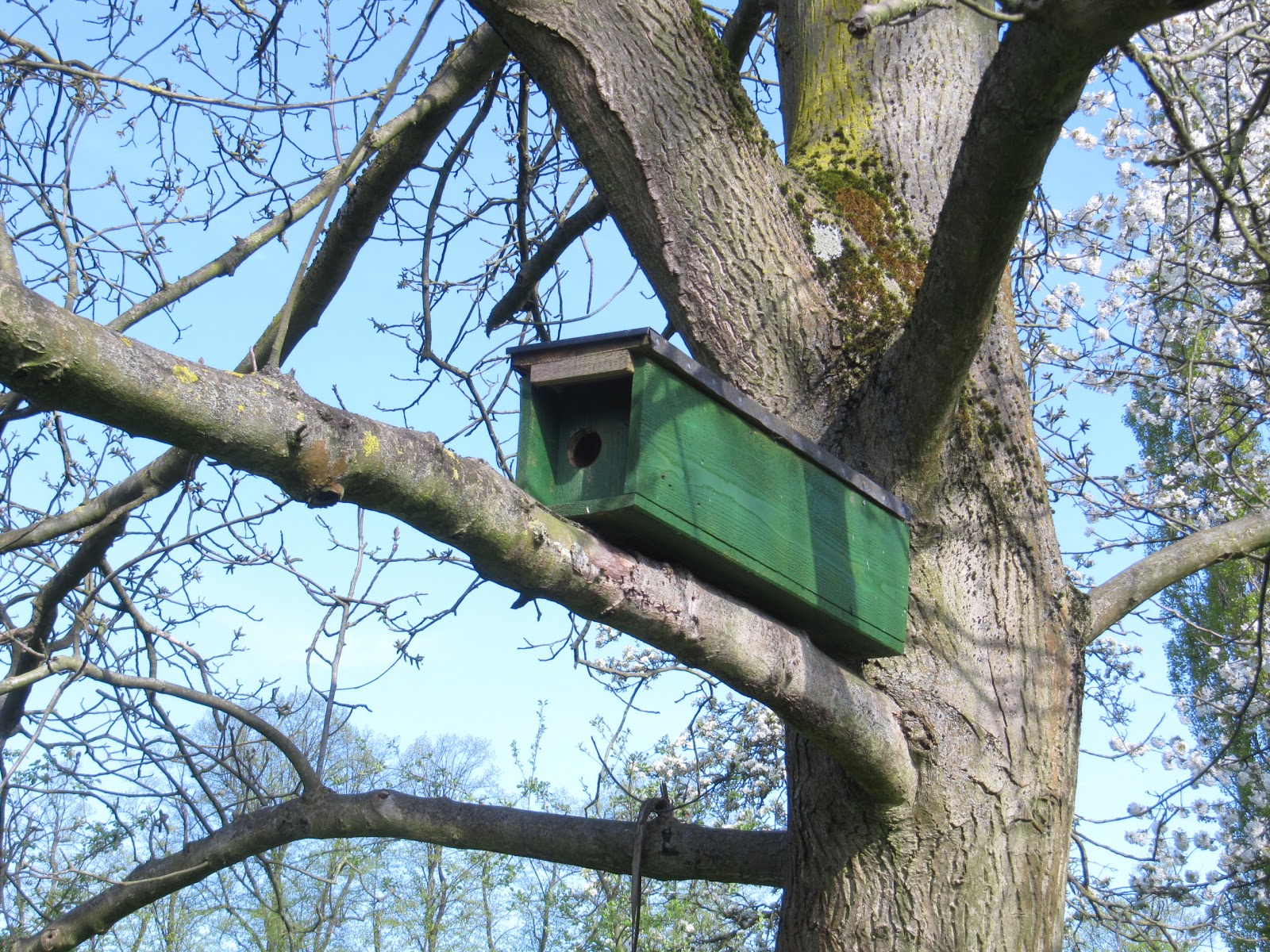
A long birdbox up in one of the trees.  I have no idea what bird would want to go in there.  It is very long but with a small hole for the entrance:


Speaking of birds, the air is filled with their song.  I see lots of Blackbirds, Robins and Wood pigeons.  Ravens fly about.  Our neighbourhood Buzzards make an appearance to a general raucous carry-on as magpies and ravens fly up to mob them.  And there are parrots:
Thank you Wikipedia
Rose-ringed parakeets.  I didn't take this photograph as these birds are too fast for this very amateur photographer.  They live all around here in Kaiserswerth and my RSPB Book of Birds calls them Ring Necked Parakeets and states they  live all over the place, from England to Istanbul.  IT describes their sound as being loud squealing, squawking calls: a very apt description.

Slowly I wend my way back home and soon I am at our front door once more.  I have been out for nearly one hour (!) but I have not found the object of my Maying. . .

The plant itself is easy enough to find as one of them is on the slopes, right near our building:


It is of course the Hawthorn.  The plant that provides the 'May', the flower, so evocative of this month.  But after a long long winter the Hawthorn is still biding its time.  Its flowers are still jealously kept from sight.
Something however tells me that it won't be too long now before all is revealed.  I shall be sure to share it with you when they appear.
I hope you enjoyed taking this May Day morning walk with me!