Sunday, 10 March 2013

A Letter of Introdution

 This past week I have felt rather like Florence Nightingale at the base hospital in Scutari:
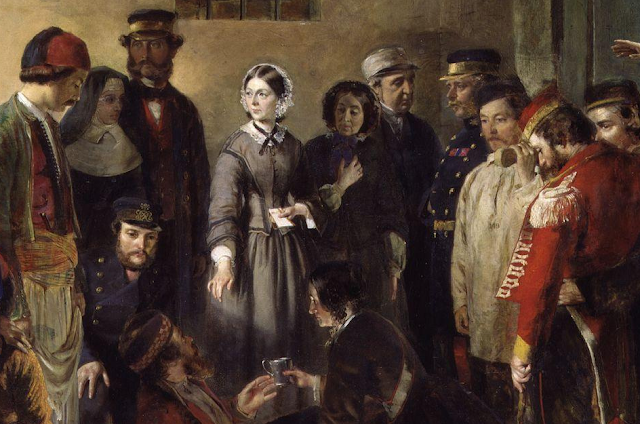

This image of Florence Nightingale is a detail of a picture that comes from Wikipedia.

Which is rather apt considering that I live in the place where she did a lot of her studies...

At present, Kaiserswerth is in the grip of a raging influenza virus that is knocking people over like ninepins.  AGA has been confined to bed with it for five days and today is his first day up and about.  He told me, that the doctor told him, that nearly half the town has it!  The usual suspects: Extreme tiredness, lack of appetite, a rumbling cough, aches and pains.  What we need is sun, sun and more sun but what we have is rain and overnight we apparently have an 87% chance of snow!  I wish Spring would get a move on.

However the purpose of this post is not to whine about illness and the weather, but rather to serve as a letter of introduction for Miss Mary Mitford and her charming book.

No, I am not referring to one of those famous (and sometimes infamous) Mitford sisters.

The Mary Mitford of whom I write was born in 1787 and died in 1855.
This image of Mary Mitford comes from Wikipedia

Here is a little something about her:
Mart Russell Mitford was born in 1787, the daughter of a Dr George Mitford who, while seemingly a very engaging personality, was a thorough wastrel and really quite a dreadful man, who spent his wife's entire fortune.
Then, when things seemed quite hopeless for the family, his daughter Mary had the good luck to pick a winning lottery ticket.  The prize was 20,000 - a large sum of money in those days and worth around 650,000 today.  Dr. Mitford with cheerful but selfish abandon, managed to spend most of that too.

It was this lack of money that spurred Mary to turn her hand to writing in an effort to support herself, and her now ageing parents.  To this end she met with some fair degree of success and while for many years the spectre of poverty was never far from the door, she was able to live a fairly comfortable life.

And while she had dreamt of becoming a poetess, and a playwright, it is for her series of country-life sketches (we might call them 'essays') that she is best remembered.  These grew out of a necessity to earn money.  The first set of sketches were published in a subscription magazine and when they proved popular, more where composed and eventually compiled in book form entitled 'Our Village'. Several more books in the same vein followed.

* * * * * *

'Our Village' is a delightful book: Both intimate and enticing.  A little window into country-life in Regency England.
The book contains no malice; no waspishness.  It is neither judgemental nor condescending.  The author is generous to her subjects and as you begin to read, you find yourself drawn into Mary's world, to extent that it is hard to put the book down!
The complete series of sketches forms a relatively large book.  I have an edition back in Melbourne but I was fortunate enough to encounter, while strolling along the Portobello Road with AGA, a truly delightful slimmer volume, dating from 1893 and consisting of a selection from the five volumes of the same title.  This forms a good introduction to her works.
The added treasure and delight of this particular book is that it is illustrated by that incomparable artist: Hugh Thomson (1860-1920).  Interestingly, the Irish-born Mr. Thomson is also known for his quality illustrations for the works of Jane Austen, Mary Mitford's contemporary and sometimes friend.

The cover (designed by the illustrator) is itself a charming piece of work, undertaken in gold leaf:
The stiff but easily removable plastic cover came with the book and I am retaining it until such time that  the book returns to Melbourne with me so that the gilding on both cover and pages, remains as bright as when it was first published.

The frontispiece gives an indication of what to expect within:

'...And one hundred illustrations by Hugh Thomson' -  Who could ask for more?

Here is the opening paragraph of the first sketch, which is entitled 'Country Pictures':
"Of all situations for a constant residence that which appears to me most delightful is a little village far in the country; a small neighbourhood, not of fine mansions finely peopled, but of cottages and cottage-like houses, 'messuages or tenements', as a friend of mine calls such ignoble and nondescript dwellings, with inhabitants whose faces are as familiar to us as the flowers in our garden; a little world of our own, close-packed and insulated like ants in an ant-hill, or bees in a hive, or sheep in a fold, or nuns in a convent, or sailors in a ship; where we know every one, and are known to every one, interested in every one, and authorised to hope that every one feels an interest in us.  How pleasant it is to slide into these true-hearted feelings from the kindly and unconscious influence of habit, and to learn to know and to love the people about us, with all their peculiarities, just as we learn to know and to love the nooks and tuns of the shade lands and sunny commons that we pass every day."

The illustrations are charming:


And each chapter has a delightful illustration to accompany it:

The character studies of the various inhabitants leaving one feeling that ones knows them as well as Miss Mitford did.  You can feel the affection she has for her fellow villagers, from the eldest down to the youngest.
One can tell that she has a deep love for the countryside and this shines forth in her descriptions.  Her love of animals is also evident and her description of village cricket (a sport she loved to watch) has led to her being described as being among the first to write on the subject.

I do like the description she gives of her own house and garden:
"Divided from the shop by a narrow yard, and opposite the shoemaker's is a habitation of whose inmates I shall say nothing.  A cottage - no - a miniature house, with many additions, little odds and ends of places, pantries and what not; all angles, and of a charming in-an-outness; a little bricked court before one half, and a little flower-yard before the other; the walls, old and weather-stained, covered with hollyhocks, roses, honeysuckles, a great apricot-tree; the casements full of geraniums (ah! there is our superb white cat peeping out from among them); the closets (our landlord has the assurances to call them rooms) full of contrivances and corner-cupboards; and the little garden behind full of common flowers, tulips, pinks, larkspurs, peonies, stocks and carnations, with an arbour of privet, not unlike a sentry-box, where one lies in a delicious green light, and looks out on the gayest of all gay flower-beds.  That house was built on purpose to show in what an exceeding small compass comfort may be packed."

I recommend to you, not only Mary Mitford but her wonderful book as well!  Do see if you are able to buy a copy, or if that proves impossible then to borrow one from your library.

Sunday, 3 March 2013

Happy 1,300th Birthday to you!

The First of March is a special day for many reasons.

Traditionally it is the first day of Spring and, I am pleased to say, the freezing cold weather does indeed appear to be on the wain.  This past week has seen the snowdrops out in force:

In Wales, the First day of March is the Feast Day of Dewi Sant, known in English as Saint David.  Saint David is the Patron Saint of Wales.

Meanwhile. . . 

. . . Here in Germany, the First of March is the feast day of another Saint: St Suitbertus, sometimes called Swidbert, or Swithbert, or even Switbert.  In this post I am going to stick with the latinized version: Suitbertus.

Suitbertus is one of the Patron Saints of Germany (there are a few).  Interestingly he, like me, was born in England, and moved to Germany for work; but while my work is in the field of education, Suitbertus' work was all about the care of souls because he was an early missionary.

They say that he came from an aristocratic family in Anglo-Saxon Northumbria and pious legend tells us that prior to his birth, a star let his parents know that their child was destined to be a great missionary.  This is why he is usually portrayed with a star in his hand:

This image comes from the following website: http://www.solingeninternet.de/sihgw/images/missionardesbergischen_stsuitbert.jpg. 
It was accessed on 1 March 2013


Born in about 650, Suitbertus was a man of action.  A Benedictine monk; he trained as a priest and spent some time studying in Ireland after which he returned to England; ready, willing, and able, to be a missionary to Northern Europe.  This work is sometimes known as the 'German mission'.
The mastermind behind the German mission was a chap named Egbert of Ripon.  He was an Anglo-Saxon priest based in Ireland where Suitbertus had studied and who was busy organising a group of missionaries to head deep into non-Christian territory.  Suitbertus was eager to take part and returning to England he met up with another chap named Willibrord.
Willibrod was in charge of the Mission.  He and his companions however were not your ordinary everyday, prayerful choir-monks.  They were aristocratic, highly educated, devil-may-care individuals ready for adventure and who were more than equal to the task at hand.  They could speak with any local ruler as with an equal, and arriving in Frisia they set to work.  They knew it was dangerous and that in all likelihood a horrible death could be their lot but still they persevered.
Frisia was the coastal region of what is now Germany and the Netherlands.  The people there were considered to be quite ferocious and I am surprised that Willibrord and his group made any headway at all.  An earlier mission led by St. Wigbert had failed, utterly destroyed by the fearful Frisian leader, Ratbod.
Ratbod was not a man to brook any opposition and he looked upon Christianity with some suspicion because his enemies, the West Franks, were themselves Christians.  He decided that he was having none of it and swept down, massacred the Frisian converts and drove the missionaries away.  Willibrord however had an ally in his work because Pepin of Heristal the Frankish leader, had recently conquered the southern part of Frisia from Ratbod and in the area safe under Pepin's rule the missionaries (including Suitbertus) were able to flourish, meeting with great success.

But Suitbertus wanted to do more.  His eye was fixed firmly on the east.

With Willibrord's blessing he left briefly for England, and was consecrated Bishop.  He then returned, and having spent some time with his old friends, headed east with a small group of followers.  He had a fair amount of success until invading Saxons undid it all.  The people he worked with were Eastern  Franks.  They were no match for the Saxon hordes who suddenly swept down upon them.  Most of the converts were massacred and Suidebertus himself taken prisoner.  Undergoing long periods of torture meant to break his spirit, he eventually managed to escape and make his way back to the land of the West Franks.  His health broken by his incarceration and periods of intense physical abuse, he was no longer able to be a part of the missions and Pepin gave him an island on the Rhine, well within Frankish territory, where he could live in peace. The island was originally known as  the Rhinhusen, then Suitbertuswerth, and eventually Kaiserswerth.
Suitbertus died 1 March 713on his island, aged about sixty-three.
By 804 he had been canonised by the Church and his remains moved to a shrine in the monastery church.
That church was burnt down some time later while Ratbod was conquering Frankish territory.  It was rebuilt after he had been soundly beaten, then destroyed, rebuilt, destroyed, rebuilt, remodelled, renovated, etc etc until we have the church as it stands today:
The relics of St Suitbertus were lost during the religious upheavals that marked the Reformation and the Counter Reformation however they were relocated in 1623 and placed within a golden shrine, modelled on the shrine of The Three Kings which can be seen within the cathedral at Koln.

Before WWII the Basilica of Kaiserswerth looked like this:
In 1945 it looked like this:

Hit by a bomb during the closing stages of the war it was the only significant damage suffered by the village.  The bombing left the interior looking like this:

Today the Basilica looks like this:
The four towers are gone.  There was no money for such extravagances when the rebuilding took place.  The end result however is still rather pleasing:

Times change everything.

St Suidbertus no longer resides within his golden shrine.  That sits on the High Altar, behind bullet-proof, shatter-proof glass so that it cannot be stolen.


The Saint himself resides in here:

Down in the crypt, but following tradition, every so many years his sacred relics are brought out, placed back in his shrine, and paraded around the village to ensure good luck and his blessings:

This photograph is on a display of the history of the Basilica.  We have not been lucky to see the event while living here but it certainly looks impressive.

So why am I telling you about all this?
Well, this week marks the 1,300th anniversary of St Suidbertus' death; his promotion to Heaven.  And despite the fact that we are officially 'enjoying our greyest ever winter on record, Kaiserswerth is in a festive mood:


There was a pontifical Mass today within the Basilica, attended by the Archbishop of Koln, and various other Church and Political Dignitaries.  Everybody wanted a little blessing from our Saint.

So, in honour of St Suitbertus, AGA and I went for a short Suitbertus inspired stroll around the village.

Snowdrops and Robins led the way, past the old house on the corner of our avenue which marks one of the old towers when we had a protective wall around us; and then down the alleyway leading to An St. Swidbert.  This road is the way 'in' to Kaiserswerth and is guarded by a statue of the good man himself:
His star sits snuggly within his crosier.

a few houses down and there is the rather exclusive Suitbertus archdiocesan Gymnasium (Senior School)
The school sits on the spot where Suitbertus' monastery was situated.  It is a somewhat dull looking, modernist structure totally not in keeping with the village but right next door is the old Capuchin Monastery which is now part of the school.  Its chapel is now the school's chapel and as the door was open, we popped inside for a look:
And there, on the side wall is a nice portrait of St Suitbertus and his star:
It was hard to take this photograph because the light was bad and the flash kept 'going off' however you get the general idea.

Continuing our 'rounds' we stopped to see how high the river was:
It has dropped considerably since the last time I looked (thank goodness).  I wondered whether if ever flooded in St Suitbertus' time?

Then we moved on to the Basilica where Holy Mass had just finished.  We stopped at the main door which isn't often used these days and has been partially blocked:
That white piece of plaster above the old door frame shows the 'Hand of God'.  It didn't come out very well in this photograph.  I might try and take a better photograph at another time.

Here is the interior showing the main altar:

It was a lot more ornate prior to the bombing but I like the airiness and the simplicity of it all as it now is.  The banner of St Suitbertus is on display and numerous votive candles have been lit today in his honour.

I hope you liked this little 'exposé' on our local Saint.

We ended our St Suidbertus day with a slice of newly made pear tart:


Well, that's all for this post.  Until next time . . .

Sunday, 24 February 2013

Cold comfort

I caught a cold this week, which has somewhat curtailed my blogging experience.

And of course, it has been snowing on and off - but the bulbs don't seem to mind.  


The weather has been blustery with a cold snap having drifted our way from Greenland of all places.  Everyone bundling up against the cold:
This squirrel lives with a group of others, in the trees outside our apartment.  He (or she) sat huddled up on this tree branch stump for about an hour, bowed down against the wintery blast!

However all is not doom and gloom because we now have two new neighbours!  
A little Blue Tit and his mate have moved in to the bird house that sits on our apartment wall.  We are being very careful not to disturb them as this is the first time that a bird has moved in on a more permanent basis.  We did have a wren in there some time back but it was only a passing visit.
Meanwhile the pot of winter aconite we bought during the week, is in flower: 

And I made bread this morning:
 

 . . . from which we cut large doorstop slices to be buttered and eaten with bowls of homemade pumpkin soup:


 The results?

As for me, I am at that stage of a cold where the worst has passed but one still feels sniffy and in need of constant pampering.
So I am sitting ensconced in silken luxury on the sofa, reading books and taking tea in between naps.  It is a hard life...
The two books are: Howitt's 'Visits to Remarkable Places' (which I purchased on our last holiday) and 'Crusader Castles' by T. E. Lawrence - yes, that T. E. Lawrence -  and a really good read too!

Friday, 15 February 2013

Kunst

While it is nice to enjoy a week's holiday lounging around at home, doing a little bit of this and a little bit of that; it is also rather nice to go out for the day.
And so with that in mind we sallied forth taking the tram in to Dusseldorf.

It was cold of course, and snowing but blue skies were confidently predicted for the afternoon...

We had an important mission in mind: To visit the Museum Kunstpalast:


The Palace of Art. 
Way way back in the 1700s Johann Wilhelm, the Elector Palatine (and a native of Dusseldorf) gave exhibitions of his collection of art works at the royal palace.  The palace is long gone and the art collection was whisked away to Munich but in the 1840s the people of Dusseldorf elected to create their own Art Collection and this formed the nucleus of the collection housed at the Kunstpalast today

I took this photograph as we left at the end of our visit and as you can see, blue skies did indeed eventuate!  At first glance it is not the most handsome of buildings, looking more like a hospital to our eyes:

However this building is one of the fruits of the short-lived Weimar Republic.  Built to plans by the architect Wilhelm Kreis who also built the Concert Hall a short distance away, it showcased the 1925 exhibition entitled: 'Großen Ausstellung für Gesundheitspflege, Soziale Fürsorge und Leibesübungen' (Great Exhibition of Health Care, Social Welfare and Physical Exercise).
A few years later and the Art collection moved in from the old Kunstpalast which is now the Art Academy.
Here is the Kunstpalast all shiny and new in 1926:
This photograph comes from the Museum website:   http://www.smkp.de/en/about/history-and-architecture.html

Upon entering, the first thing you see is the huge stained glass windows by the famous Dutch artist, Jan Thorn Prikker:
I found this window to be soothing.  With its jazz-age overtones I think that it compliments the building perfectly.

Here are a few highlights from the kunstpalast that I thought I would share with you but I should warn you that some of the photographs may be a little blurred because naturally, no flash photography was allowed inside.

Look at the beauty to be found in the wonderful hymnal.  I liked the little attention to detail in the birds:


These sixteenth century prancing, capering angels are wonderful!  I had never seen them carved with a covering of feathers before.  I really like them:

There is a large collection of Japanese netsuke (toggles) on display as well.  I like this one of the half mouse (?) half man.  Next to him was a kimono wearing cat person:

 This painting of 'Jonah and the Whale' could quite happily live in our apartment:
 Painted by Pieter Lastinan it shows the whale literally spitting Jonah out of its mouth.  Jonah goes flying through the air although his robe always remains strategically placed.  I particularly like the velvety look to the body of the 'whale' and its unusual eye!

Although I seriously blurred this photograph of a fifteenth century carving of Our Lady, together with the Infant Jesus and her parents, I wanted to show it because of the wonderful attention to detail, and skill used by the carver:
Just look at that hand turning the page of the book.

And speaking of attention to detail, look at this wonderful painting by Adrien van der Spelt:


UPon entry we were told that parts of the Art Gallery were closed but we didn't mind because it gave us longer to visit the Hentrich Glass Museum which is in the same building.  It is one of the largest glass museums in Europe and has glassware dating back over 2,000 years...

Roman and Egyptian glassware:

These 19th Century vases are beautiful:

This 16th Century vase is made to look like cracked ice:


This very pretty, hand painted vase is rather small but the detail is wonderful:

Isn't this 16th Century glass plate magnificent?

Here is a sixteenth century novelty jug in the shape of a soldier (without head):

There was a large collection of modern glass creations as well:


But could they match this 17th century glass teapot from the Netherlands?  It would fit very well into my own collection!:


Finally,  I'm not sure but that blurred, ghost like person walking down the stairs in front of me could be AGA...